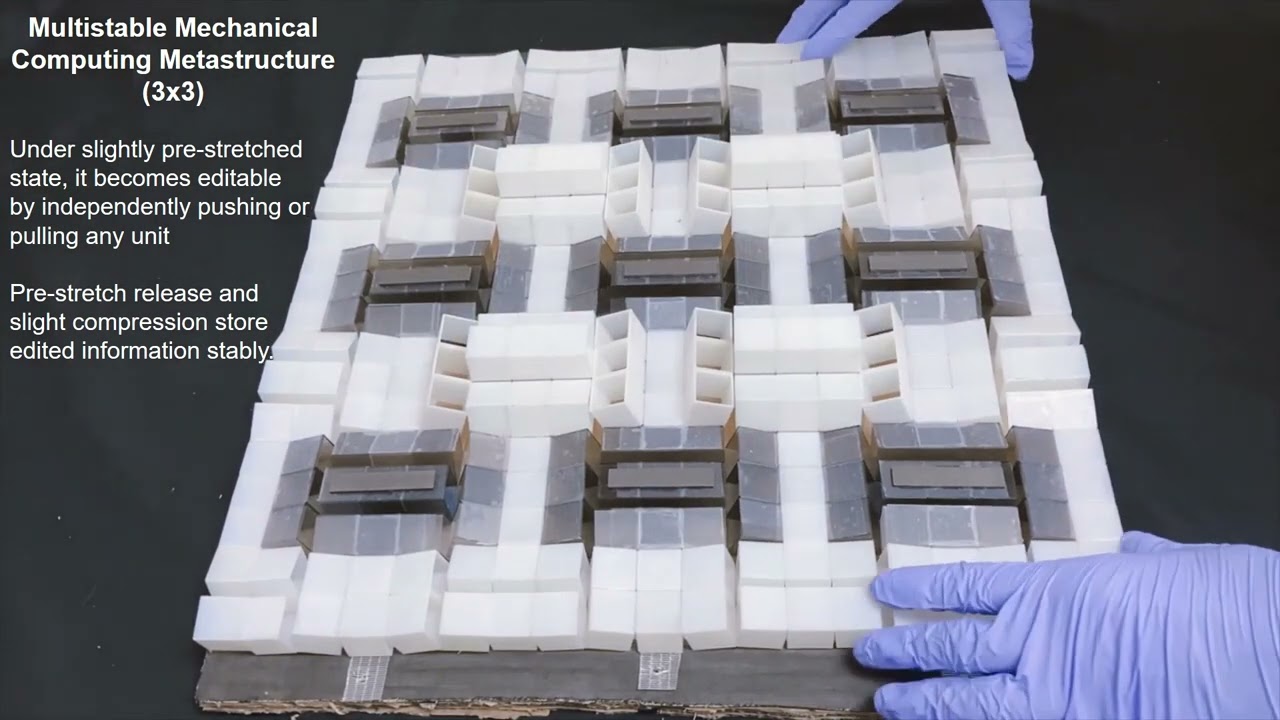
Researchers have built a mechanical computer inspired by kirigami, the Japanese art of paper-folding and cutting.
The proof-of-concept computer, which includes no electronic components, has 64 interconnected, 0.06 cubic inch (1 cubic centimeter) polymer cubes that can be rearranged to store, retrieve and erase data. Similar to kirigami, where paper is cut and folded into intricate designs, the computer can be physically manipulated into different configurations and states.
In this machine, each cube represents a bit of binary data, which can be pushed up or down to represent 1 or 0, respectively. Rearranging the cubes changes the computer's configuration, enabling information to be stored or represented in physical form.
Latest Videos FromLive Science
The scientists said the concept could be used to create physical encryption-decryption systems, or even develop touch-based systems for 3D environments.
"For example, a specific configuration of functional units could serve as a 3D password," lead study author Yanbin Li, a postdoctoral researcher at North Carolina State University's College of Engineering, said in a statement. "We’re also interested in exploring the potential utility of these metastructures to create haptic systems that display information in a three-dimensional context, rather than as pixels on a screen."
Related: 'Quantum-inspired' laser computing is more effective than both supercomputing and quantum computing, startup claims
The researchers published their research June 26 in the journal Science Advances.
Mechanical computers date back centuries — potentially as early as the second century B.C. — long before the invention of algorithms and programming languages as we know them today. Unlike this new kirigami-inspired concept, however, people operated these machines with gears or levers, making them extremely clunky.
In the new computer, changing the position of one cube changes the position of all connected cubes — altering the computer's configuration to correspond with different computational states.
"Using a binary framework — where cubes are either up or down — a simple metastructure of 9 functional units has more than 362,000 possible configurations," Li said.
Data editing is controlled by pulling on the edges of the metastructure, which stretches elastic tape and pushes the cube up or down. When the tape is released, it locks the cubes, and the data, in place. The cubes can also be pushed up or down remotely by attaching a magnetic plate to the computer and applying a magnetic field.
The researchers said the system could allow for more complex computing beyond binary code, with cubes capable of occupying states of not just 1 or 0 but 2, 3 and 4.
"Each functional unit of 64 cubes can be configured into a wide variety of architectures, with cubes stacked up to five cubes high," study co-author Jie Yin, an associate professor of mechanical and aerospace engineering at NC State, said in the statement. "This allows for the development of computing that goes well beyond binary code."
Next, the researchers hope to team up with programmers to develop code for the computer. "Our proof-of-concept work here demonstrates the potential range of these architectures, but we have not developed code that capitalizes on those architectures," Li said. "We’d be interested in collaborating with other researchers to explore the coding potential of these metastructures."