













Antikythera mechanism, world's oldest computer, followed Greek lunar calendar
Researchers previously thought the calendar ring on the Antikythera mechanism tracked the ancient Egyptian calendar, but new research suggests it tracked the Greek lunar calendar instead.

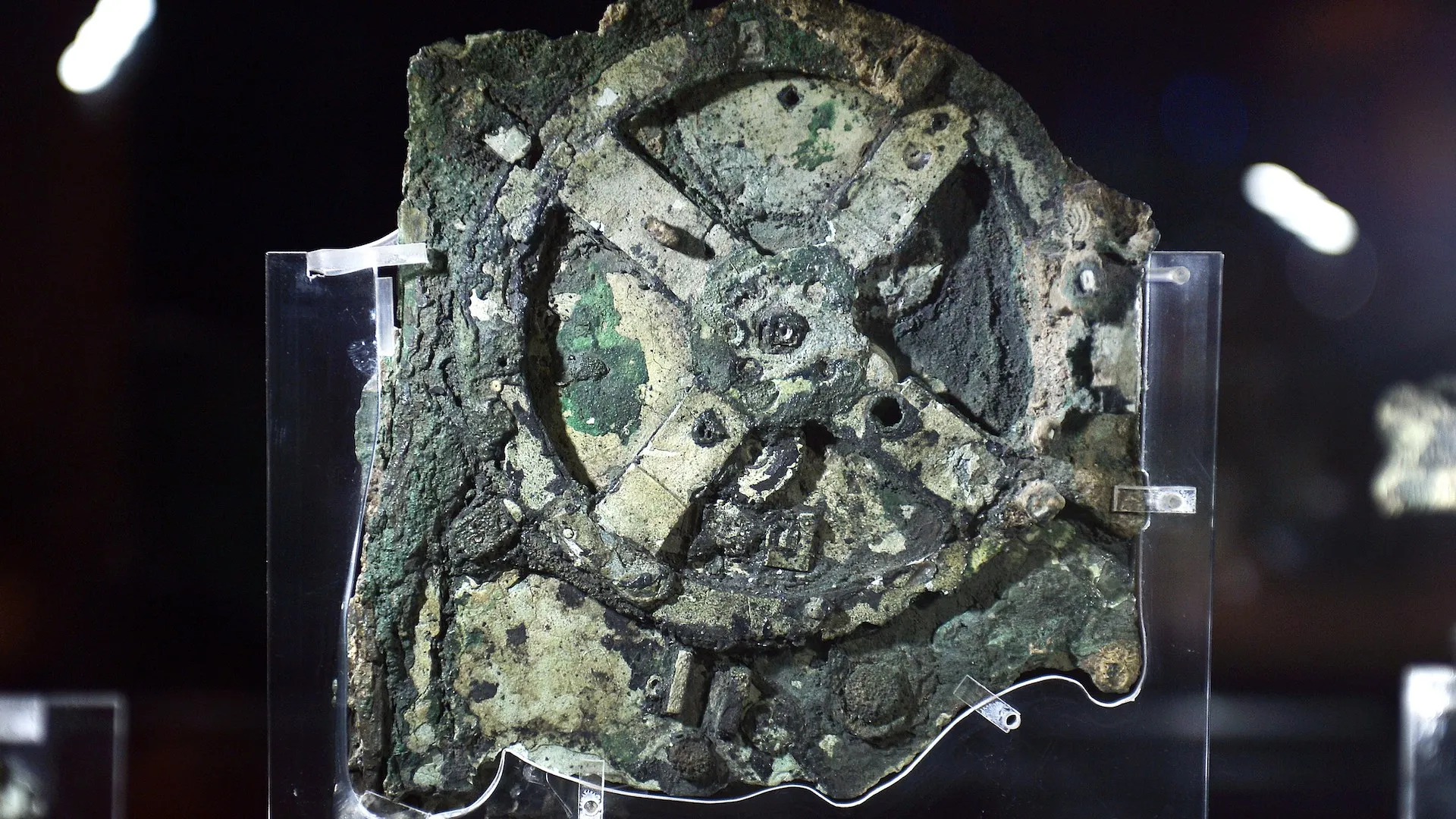
The Antikythera mechanism — an ancient shoebox-sized device that was used to track the motions of the sun, moon and planets — followed the Greek lunar calendar, not the solar one used by the Egyptians, as was previously thought, new research reveals.
The Antikythera mechanism, found by sponge divers off the Greek island of Antikythera in 1901, was created around 2,200 years ago. The device, which contains bronze gears, has sometimes been called the world's oldest computer.
One piece of the mechanism, known as the "calendar ring," was used to track the days of the year, with one hole per day. While the ring has been known about for some time, it’s only partially preserved, so it's unclear how many days it was meant to track.
In 2020, a team led by independent researcher Chris Budiselic used new X-ray images of the device, combined with measurements and mathematical analysis, to determine that the mechanism likely didn't cover a full solar calendar year but rather 354 days, as would be used in a lunar calendar.
On Thursday (June 27), another paper in The Horological Journal found a similar result. A team from the University of Glasgow used statistical techniques developed for the Laser Interferometer Gravitational-Wave Observatory to detect gravitational waves — ripples in space-time produced by the collisions of massive celestial objects such as black holes. These statistical methods are sensitive enough to detect the faint signals from a potentially very noisy background.
When the researchers trained the powerful statistical technique on the Antikythera mechanism, they were able to use the positioning of the known holes, as well as the likely way the fragments of the mechanism fit together, to deduce the number and placement of the lost holes. They ultimately determined that the mechanism likely had 354 or 355 holes. This meant it likely followed the 354-day lunar calendar used in Greece at the time, rather than the 365-day calendar used by the ancient Egyptians.
It had been thought that it might have used the 365 Egyptian solar calendar since it's more accurate than the 354 day lunar calendar.
Get the world’s most fascinating discoveries delivered straight to your inbox.
"Glasgow team's results provide fresh evidence that one of the components of the Antikythera mechanism was most likely used to track the Greek lunar year," the researchers said in a statement from the university.
The team was impressed with the device creators' attention to detail.
"The precision of the holes' positioning would have required highly accurate measurement techniques and an incredibly steady hand to punch them," study co-author Graham Woan, an astrophysics professor at the University of Glasgow, said in the statement. "It's a neat symmetry that we've adapted techniques we use to study the universe today to understand more about a mechanism that helped people keep track of the heavens nearly two millennia ago."
RELATED STORIES
Andrew Thoeni, a co-author of the 2020 paper, praised the new research. "We are very happy that more scholars are now accepting and validating our findings," Thoeni told Live Science in an email.
Diomidis Spinellis, a professor of software engineering at the Athens University of Economics and Business who has researched the mechanism but was not involved in either paper, was also impressed with the new work.
"The Antikythera mechanism is a gift that keeps on giving," Spinellis told Live Science in an email. "Despite its severe corrosion and many missing elements, the application of increasingly sophisticated technologies and innovative cross-disciplinary analysis continues to provide impressive insights into this remarkable artifact."

Owen Jarus is a regular contributor to Live Science who writes about archaeology and humans' past. He has also written for The Independent (UK), The Canadian Press (CP) and The Associated Press (AP), among others. Owen has a bachelor of arts degree from the University of Toronto and a journalism degree from Ryerson University.