-
 Evidence of Universe's Inflation Lurks in New Data
Scientists hope that in just a few months they may get a confirmation of whether accelerated expansion of the universe did indeed take place in the first fleeting moments after the Big Bang.
cosmology -
 Giant Moon-Forming Impact On Early Earth May Have Spawned Magma Ocean
Moon-forming giant impact caused a giant magma ocean on Earth; life appeared millions of years later, hitching a ride on a Martian rock, a scientist says.
the-moon -
Was the Early Moon Made of Magma 'Mush'?
The young moon may have been a magma "mush" for hundreds of millions of years before it solidified, a scientist says.
the-moon -
 Going Back to the Moon Could Settle Questions about Lunar Origin
In order to truly answer the unsolved mysteries of the moon's origin, new missions to retrieve samples of the lunar surface and return them to Earth will be needed, one scientist said.
the-moon -
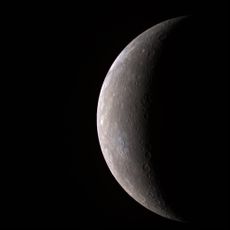 Does Mercury Hold Clues to Birth of Earth's Moon?
Just like the moon, Mercury is a desolate, rocky and airless body, albeit a bit bigger than Earth's satellite, said Sean Solomon, the principal investigator for NASA's Messenger mission to Mercury.
mercury -
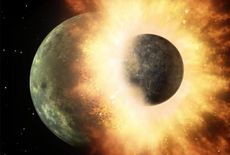 Giant Impact That Formed the Moon Blew Off Earth's Atmospherethe-moon
 -
 Did Venus Give Earth the Moon? Wild New Theory on Lunar History
Is the moon a present from Venus, which once had a moon and then lost it? A wild new theory puts the scenario out there.
venus -
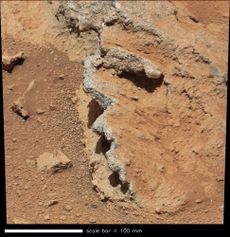 Water on Mars: Curiosity Rover Uncovers a Flood of Evidencemars
 -
 Human Touch: Sensor Lets Robots 'Feel'physics-mathematics
 -
 Atomic Clocks to Become Even More Accurate
The ultraprecise ticker could be used to prove Einstein's general relativity and create more precise GPS systems.
technology -
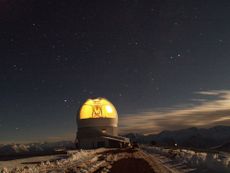 New Laser Vision Helps Telescope Probe Distant Star Cluster
The faraway star cluster NGC 6496 is 10.5 billion years old and 32,600 light-years away.
astronomy