One of Earth's oldest rocks may have been dug up on the moon.
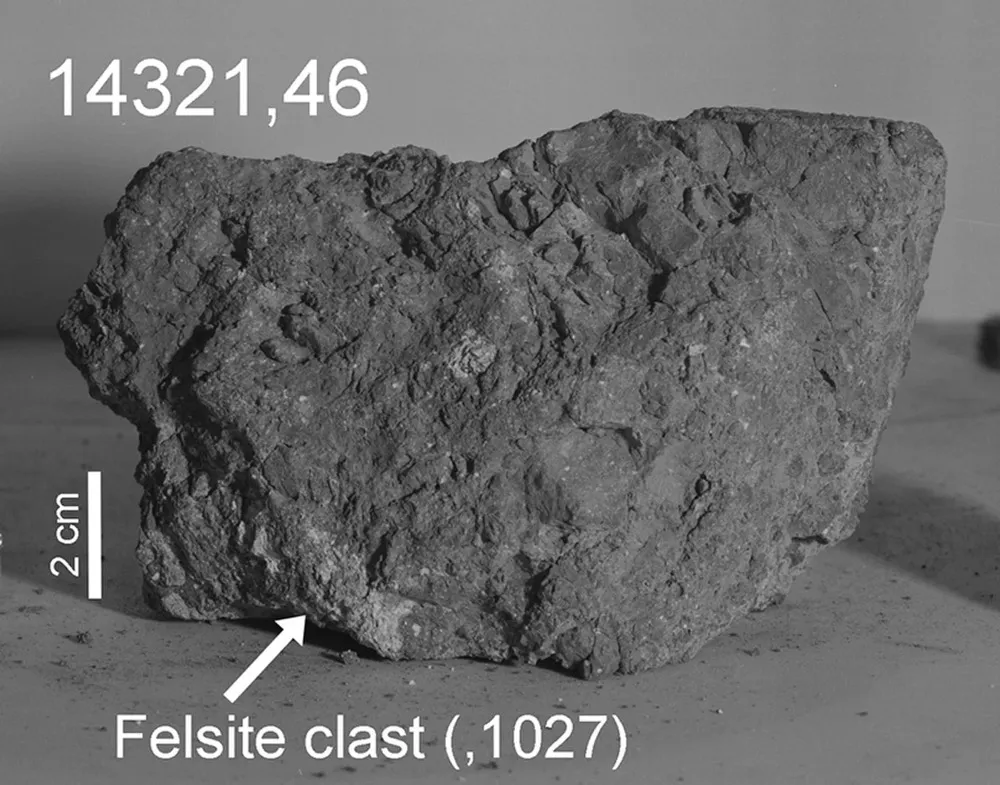
A chunk of material brought back from the lunar surface by Apollo astronauts in 1971 harbors a tiny piece of Earth, a new study suggests. The Earth fragment was likely blasted off our planet by a powerful impact about 4 billion years ago, according to the new research.
"It is an extraordinary find that helps paint a better picture of early Earth and the bombardment that modified our planet during the dawn of life," study co-author David Kring, a Universities Space Research Association (USRA) scientist at the Lunar and Planetary Institute in Houston, said in a statement. (Biologists generally believe that life got a foothold on Earth between 4.1 billion and 3.8 billion years ago.) [How the Moon Formed: 5 Wild Theories]
The research team — led by Jeremy Bellucci, of the Swedish Museum of Natural History, and Alexander Nemchin, of the Swedish Museum and Curtin University in Australia — analyzed lunar samples collected by members of the Apollo 14 mission, which explored the lunar surface for a few days in early February 1971.
The scientists found that one rock contained a 0.08-ounce (2 grams) fragment composed of quartz, feldspar and zircon, all of which are rare on the moon but common here on Earth. Chemical analyses indicated that the fragment crystallized in an oxidized environment, at temperatures consistent with those found in the near subsurface of the early Earth, study team members said.
An artist's illustration of the Hadean Earth, when the rock fragment was formed. Impact craters, some flooded by shallow seas, cover large swaths of the Earth's surface. The excavation of those craters ejected rocky debris, some of which hit the moon.
(Image credit: Simone Marchi)
The available evidence suggests that the fragment crystallized 4.1 billion to 4 billion years ago about 12 miles (20 kilometers) beneath Earth's surface, then was launched into space by a powerful impact shortly thereafter.
The voyaging Earth rock soon made its way to the moon, which was then about three times closer to our planet than it is today. (The moon is still retreating from us, at a rate of about 1.5 inches, or 3.8 centimeters, per year.) The fragment endured further trauma on the lunar surface. It was partially melted, and probably buried, by an impact about 3.9 billion years ago, then excavated by yet another impact 26 million years ago, the researchers said.
Sign up for the Live Science daily newsletter now
Get the world’s most fascinating discoveries delivered straight to your inbox.
This photo by NASA's Lunar Reconnaissance Orbiter shows the Apollo 14 landing site and nearby Cone Crater. The trail followed by the Apollo 14 astronauts can be seen. Image width is 1 mile (1.6 kilometers).
(Image credit: NASA/GSFC/Arizona State University)
This latest collision created the 1,115-foot-wide (340 meters) Cone Crater, whose environs Apollo 14 astronauts Alan Shepard and Edgar Mitchell explored and sampled 47 years ago. (The third Apollo 14 crewmember, Stuart Roosa, stayed in lunar orbit aboard the mission's command module.)
An Earth origin for the ancient fragment isn't a slam dunk, study team members stressed. However, it is the simplest explanation; a lunar birth would require a rethink of the conditions present in the moon's interior long ago, the researchers said.
Mike Wall's book about the search for alien life, "Out There" (Grand Central Publishing, 2018; illustrated by Karl Tate), is out now. Follow him on Twitter @michaeldwall. Follow us @Spacedotcom or Facebook. Originally published on Space.com.
Michael was a science writer for the Idaho National Laboratory and has been an intern at Wired.com, The Salinas Californian newspaper, and the SLAC National Accelerator Laboratory. He has also worked as a herpetologist and wildlife biologist. He has a Ph.D. in evolutionary biology from the University of Sydney, Australia, a bachelor's degree from the University of Arizona, and a graduate certificate in science writing from the University of California, Santa Cruz.