













Total Eclipse, Partial Failure: Tales of Scientific Missions Gone Bad
This article was originally published at The Conversation. The publication contributed the article to Live Science's Expert Voices: Op-Ed & Insights.
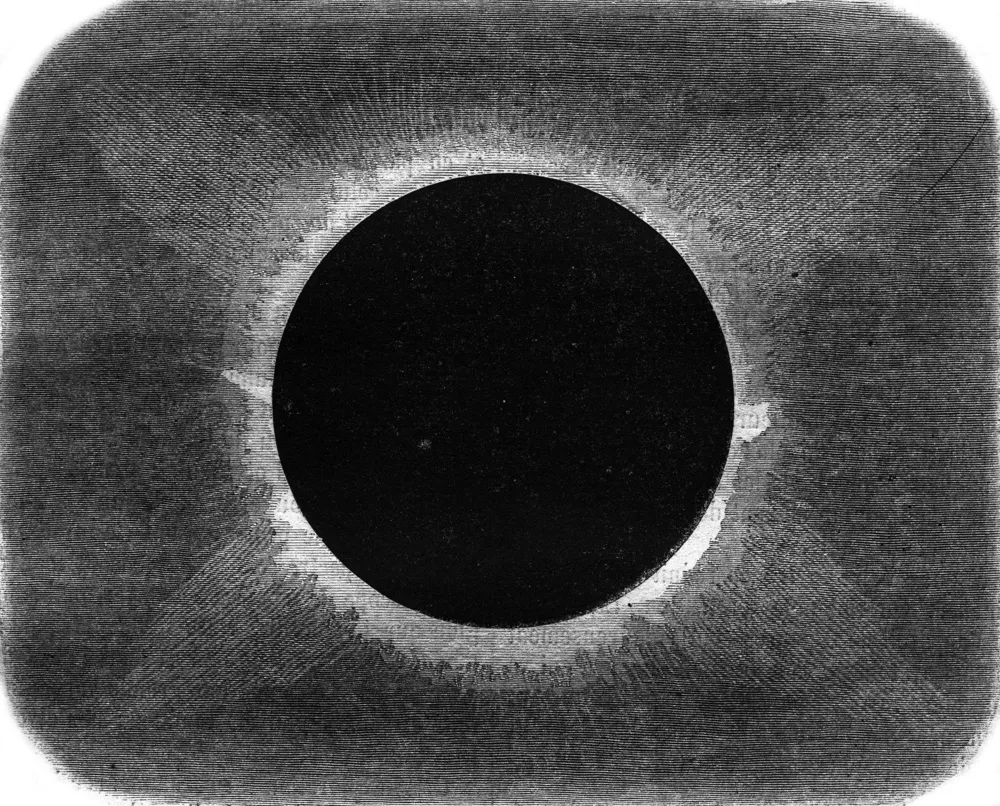
For centuries, astronomers have realized that total solar eclipses offer a valuable scientific opportunity. During what's called totality, the opaque moon completely hides the bright photosphere of the sun – its thin surface layer that emits most of the sun's light. An eclipse allows astronomers to study the sun's colorful outer atmosphere and its delicate extended corona, ordinarily invisible in the dazzling light of the photosphere.
But total solar eclipses are infrequent, and are visible only from a narrow path of totality. So eclipse expeditions require meticulous advance planning to ensure that astronomers and their equipment wind up in the right place at the right time. As the history of astronomy shows, things don't always go according to plan for even the most prepared eclipse hunters.
Into hostile territory, at the mercy of the map
Samuel Williams, the newly appointed professor of mathematics and natural philosophy at Harvard College, was eager to observe a total solar eclipse. He'd seen a transit of Venus in 1769, but had never had the chance to study the sun's corona during an eclipse. According to his calculations, a total solar eclipse would be visible from Maine's Penobscot Bay on Oct. 27, 1780.
But reaching Maine from Massachusetts would be something of a problem; the Revolutionary War was raging, and Maine was held by the British Army. The Massachusetts legislature came to Williams' assistance; it directed the state's Board of War to fit out a ship to convey the eclipse hunters. Speaker of the House John Hancock wrote to the British commander in Maine, requesting permission for the men of science to make their observations. When the astronomer-laden ship arrived at Penobscot Bay, Williams and his team were permitted to land but restricted to the island of Isleboro, three miles offshore from the mainland.
The morning of the big day was cloudless. As the calculated moment of totality approached, at half past noon, the excitement built. The sliver of uneclipsed sun became narrower and narrower.
Then, at 12:31 p.m., it started becoming wider and wider. Williams realized, to his frustration, that he wasn't in the path of totality after all. They were 30 miles too far south.
Get the world’s most fascinating discoveries delivered straight to your inbox.
After a subdued voyage back to Massachusetts, Williams tried to determine what had gone wrong. Some astronomers, at the time and in following centuries, suggested his calculations of the path of totality were inaccurate.
Williams, however, had a different explanation. In his report to the newly founded American Academy of Arts and Sciences, he blamed bad maps:
"The longitude of our place of observation agrees very well with what we had supposed in our calculations. But the latitude is near half a degree less than what the maps of that country had led us to expect."
Since half a degree of longitude corresponds to 30 nautical miles, this could explain why Williams ended up too far south.
Although Samuel Williams missed seeing a total eclipse, his expedition was not a total failure. While watching the narrow sliver of sun visible at 12:31, he noted it became "broken or separated into drops." These bright drops, known today as Baily's Beads, are the result of the sun's light shining through valleys and depressions along the moon's visible edge. They're named in honor of astronomer Francis Baily; however, Baily saw and described the beads in 1836, nearly 56 years after Williams observed them.
Hard to observe with smoke in your eyes
Almost a century later, in 1871, English astronomer Norman Lockyer was eager to observe a total solar eclipse.
Three years earlier, he and French astronomer Jules Janssen had independently measured the spectrum of the sun's chromosphere; to their surprise, they found an emission line in the yellow range of the spectrum, not corresponding to any known element.
Lockyer boldly claimed that the emission line was from a new element that he named "helium," after the sun god Helios. Realizing that eclipses offered a helpful opportunity to search for more undiscovered elements, Lockyer became a strong advocate of eclipse expeditions. He knew the total solar eclipse of Dec. 12, 1871 would pass across southern India and persuaded the British Association for the Advancement of Science to sponsor an expedition. Wishing to show that British rule in India was linked to scientific progress, the British government chipped in £2,000, and the P&O steamship company offered reduced fares to India for the eclipse hunters.
Lockyer's voyage to India went smoothly. (This could not be taken for granted; in 1870, on his way to view an eclipse from Italy, Lockyer was aboard a ship that ran aground off the east coast of Sicily.) The team set up their instruments on a tower at Bekal Fort, on the southwest Indian coast. The morning of Dec. 12, 1871 was cloudless. Although Lockyer was suffering from a fever (and from the effects of the opium he was taking to treat it), he was ready.
Then, during the initial phases of the eclipse, he noted odd activity in the region below the fort. Local inhabitants were gathering a huge pile of brushwood to fuel a bonfire; apparently, by creating a bright fire on Earth, they hoped to encourage the darkening sun to become bright again. Lockyer was alarmed; the column of smoke would have risen directly between him and the eclipsed sun, ruining his observations.
Fortunately, the local superintendent of police happened to be present; he summoned a squadron of policemen who put out the fire and dispersed the crowd. During the now smoke-free eclipse, Lockyer made valuable observations of the structure of the sun's corona.
To see an eclipse you must see the sun
Jump ahead to the early 20th century. The English Astronomer Royal Sir Frank Dyson was eager to view a total solar eclipse. He didn't have to travel far, since the eclipse of June 29, 1927 had a path of totality cutting across northern England, from Blackpool in the west to Hartlepool in the east. As an eminent figure in the scientific establishment and a renowned expert on eclipses, Dyson had no trouble in commanding financial support for his eclipse observations.
What he could not command, however, was the famously fickle English weather. During the month of June, northern England averages about seven hours of direct sunlight per day; however, this comes from a mix of weather that includes completely overcast days and completely cloudless days. Dyson didn't know what to expect.
After checking the weather records along the predicted eclipse path, Dyson decided to observe from the Yorkshire village of Giggleswick. As he and his team prepared for the eclipse, the location choice initially seemed dubious; for two weeks before the eclipse, the sky was completely cloudy every afternoon, at the time of day when totality would occur on June 29.
Despite the grimly unpromising weather, crowds of hopeful people converged on the widely publicized eclipse path. Railway companies ran special excursion trains, towns along the path of totality sponsored "eclipse dances" and newspapers offered "ecliptoglasses" to subscribers.
In the end, unfortunately, most viewers along the eclipse path were disappointed. From the errant cloud that blocked the totally eclipsed sun from Blackpool Tower to the unbroken overcast sky at Hartlepool, the weather did not cooperate.
Happily for Frank Dyson, however, the town of Giggleswick was nearly the only location along the eclipse path that had clear skies during totality. The estimated 70,000 people who converged there, following the lead of the astronomer royal, also benefited from Dyson's good luck.
After the eclipse, Dyson's public statement was, by British standards, positively bubbly:
"The photographs have come out extremely well. A very clear and striking eclipse. Our observations went off very well indeed."
Despite the difficulties posed by weather… and smoky bonfires… and dodgy maps… astronomers have always persevered in their quest to view eclipses.
Barbara Ryden, Professor of Astronomy, The Ohio State University
This article was originally published on The Conversation. Read the original article.