













No Batteries Required: Future Devices Could Power Themselves
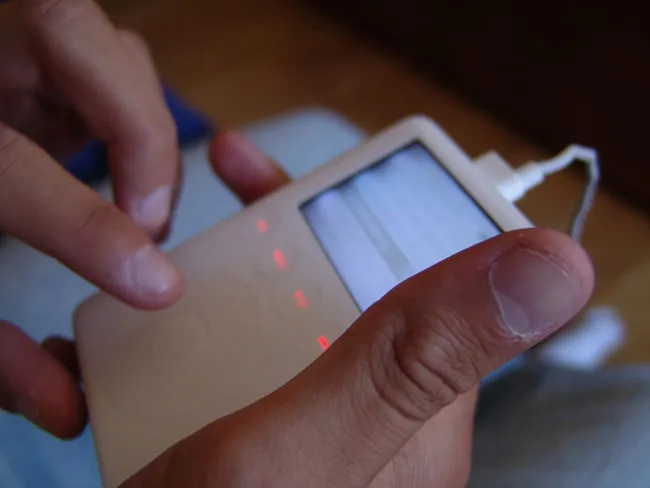
A dying battery on a cell phone or iPod is usually a simple inconvenience, but it can potentially ruin lives. Research now shows that high-tech devices will be able to power themselves in the future by converting pressure waves into energy. No recharge needed. The findings, detailed in this fall in the journal Physical Review B, could have potentially profound effects for low-powered electronic devices such as laptops, personal communicators and a host of other computer-related devices used by everyone from the average consumer to law enforcement officers and even soldiers in the battlefield. The field behind this innovation is "piezoelectrics," which aims to develop self-powering electronics, eliminating the need for replaceable power supplies, such as batteries. Piezoelectrics are actually materials, such as crystals or ceramics, which generate a significant amount of voltage when a form of mechanical stress is applied, such as a push. The concept isn’t new. It was used in sonar devices during World War I, and is applied today in car cigarette lighters. Pressing down the lighter button causes impact on a piezoelectric crystal that in turn produces enough voltage to create a spark and ignite the gas. There are other mechanisms other than "pushing" that can generate pressure waves to spark energy in piezoelectric materials. Imagine a self-powering cell phone, for instance, that never needs to be charged because it converts sound waves produced by the user into the energy it needs to keep running.
Some night clubs in Europe now feature dance floors built with piezoelectrics that absorb and convert energy from footsteps in order to help power lights in the club. And a Hong Kong gym reportedly is using the technology to convery energy from exercisers to help power its lights and music.
Tahir Cagin, a chemical engineer at Texas A&M University, and his partners from the University of Houston, study the piezoelectric concept. For this project, they fine-tuned piezoelectric materials with nanoscale dimensions (atoms and molecules are measured in nanometers, and a human hair is about 100,000 nanometers wide). Studying piezoelectrics in microscopic units is a relatively new endeavor, but a key step along the road toward inventing a self-powering cell phone and other portable, high-tech devices, which contain these minute components already. Specifically, Cagin and his team have found that a certain type of piezoelectric material can double its energy output when manufactured at a very small size — in this case, around 21 nanometers in thickness. "The material [that we’re working with] has a property which has the mechanics to harvest energy. We anticipated that once the materials decreased to nanoscale dimensions, there would be an increase in energy-converting performance. Then we wanted to know that if the dimensions were made smaller and smaller, if there would be a constant change coupled with that," Cagin told LiveScience. But as it turns out, when materials are constructed bigger or smaller than around 21 nanometers in thickness, they show a significant decrease in their energy-converting capacity, he added. Significant changes in scale, especially within such minuscule units, makes a material react differently and become more susceptible to change from its surrounding environment. "Right now, we’re looking into materials and material systems that harvest different sources of energy, such as thermal and mechanical energy, and their influences for small and large-scale applications," Cagin said. "We also wish to mix together these different materials and their processing approaches to generate structures for improved energy-harvesting performance."
- 10 Technologies That Will Transform Your Life
- Video - Cell Phones and Microscopes Get Together
- Is Technology Rewiring Our Brains?
Get the world’s most fascinating discoveries delivered straight to your inbox.