














NASA Probes Near Sun Safe from Triple Solar Eruption

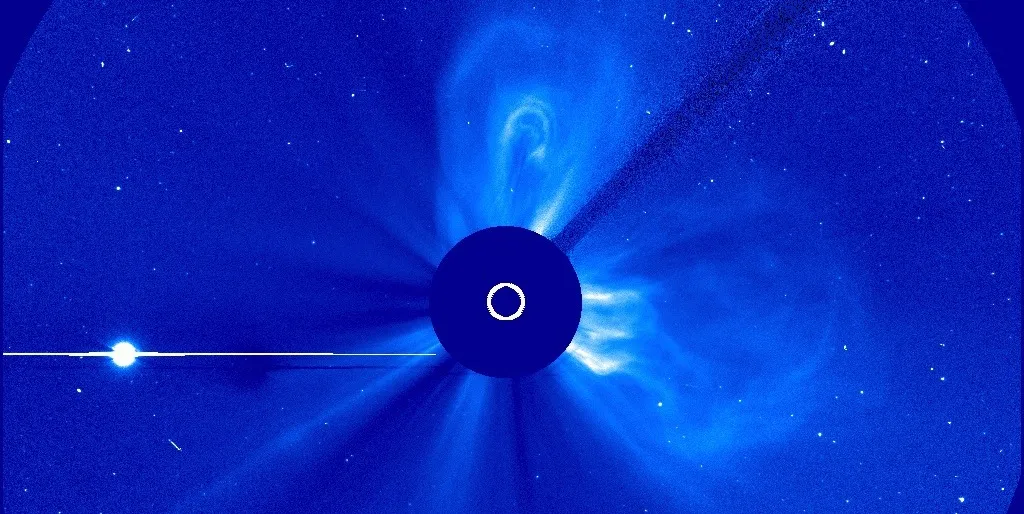
Two NASA spacecraft are safe and sound, after the sun unleashed three intense back-to-back solar eruptions in their direction, scientists say.
NASA's Messenger spacecraft in orbit around Mercury and the Stereo-A, which studies the sun from Earth orbit, suffered no damage from the passing solar storms.
On April 20, the sun fired off a solar eruption that sent huge wave of plasma and charged particles, called a coronal mass ejection (CME), toward Mercury. The next day, the sun unleashed two more CMEs in the same direction, and managers from both the Messenger and Stereo missions were alerted of the potential hazards should the CMEs hit or pass closely to the probes.
But, it appears both spacecraft made it through unscathed.
"The CME did pass by Stereo-A — we can see it in the data," said C. Alex Young, a solar astrophysicist at NASA's Goddard Space Flight Center in Greenbelt, Md. "Other than that, we didn't see anything out of the ordinary."
In severe cases, CMEs can scramble a spacecraft's onboard electronics, but these particular eruptions were not very strong, Young explained. Still, spacecraft manufacturers are mindful of the amount of radiation their hardware will likely be exposed to in space.
"These spacecraft, while they certainly can be affected by spaceweather, they're generally made to withstand reasonable amounts of radiation," Young told SPACE.com.
Get the world’s most fascinating discoveries delivered straight to your inbox.
Stereo-A is one of a pair of twin space probes tasked with monitoring solar weather events. The Stereo spacecraft (short for Solar Terrestrial Relations Observatory) were both launched in 2006.
NASA's Messenger spacecraft has been orbiting Mercury since March 2011. The mission completed its first full map of Mercury's surface last month.
The sun's activity ebbs and flows on an 11-year cycle, and solar weather events are expected to increase this year as the current cycle ramps up toward the solar maximum. The current solar weather cycle is known as Solar Cycle 24.
This story was provided by SPACE.com, a sister site to Live Science. Follow Denise Chow on Twitter @denisechow. Follow us @Spacedotcom, Facebook or Google+. Originally published on SPACE.com.

Denise Chow was the assistant managing editor at Live Science before moving to NBC News as a science reporter, where she focuses on general science and climate change. Before joining the Live Science team in 2013, she spent two years as a staff writer for Space.com, writing about rocket launches and covering NASA's final three space shuttle missions. A Canadian transplant, Denise has a bachelor's degree from the University of Toronto, and a master's degree in journalism from New York University.