














The Universe Today: What It All Looks Like Now

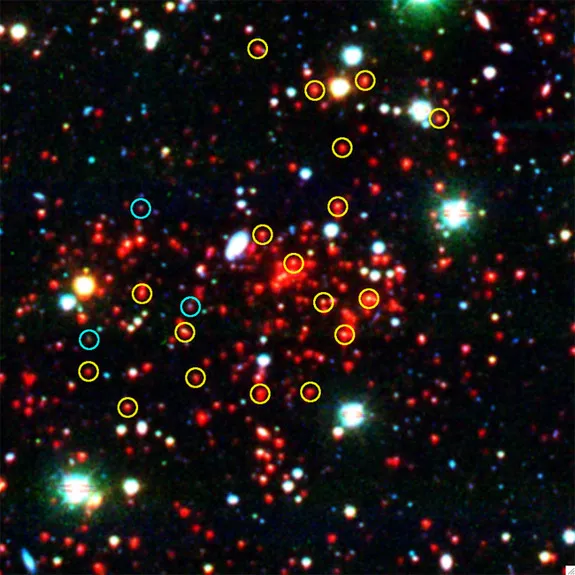
It took quite a bit more than seven days to create the universe as we know it today. SPACE.com looks at the mysteries of the heavens in our eight-part series: The History & Future of the Cosmos. This is Part 7 in that series.
In the 1920s, astronomer Georges Lemaître proposed what became known as the Big Bang theory, which is the most widely accepted model to explain the formation of the universe.
In the decades since, theoretical physicists have scoured the cosmos for evidence to support the Big Bang theory. While they have shed light on many long-standing mysteries, some of the most groundbreaking discoveries have also given rise to even more perplexing puzzles that remain to be solved.
As cosmologists continue to piece together details surrounding the birth of the universe roughly 13.7 billion years ago, they are also gaining a better understanding of our universe today.
"It's certainly a period of time where tremendous progress has been made," said David Spergel, chair of the astrophysics department at Princeton University in Princeton, N.J. "When I was a graduate student in the '80s, we did not know the age of the universe. We did not know its composition. We did not understand the origin of galaxies. We've made a lot of progress on all these topics." [The Big Bang to Now in 10 Easy Steps]
The beginning of the universe
According to the Big Bang theory, our universe began as an extremely hot and extremely dense state that underwent rapid and colossal expansion.
Get the world’s most fascinating discoveries delivered straight to your inbox.
"It was very hot, very dense, and nearly uniform," Spergel told SPACE.com. "As it expanded, it became cooler and less dense."
But, despite what the theory's name suggests, the origin of the universe was not really an explosion, said Charles Bennett, an astrophysicist and professor at Johns Hopkins University in Baltimore, Md.
"Most people think of the Big Bang as a big explosion that happened in space, but that's not really what we mean," Bennett told SPACE.com. "We're not talking about an explosion. It's better to think of the growth of the universe as something that happened everywhere at once.”
Cosmologists do not have a clear understanding of what came just before this moment.
"Well, we could say it was hotter and denser, but the short answer is that we don't know," Bennett said.
Fractions of a second after the Big Bang — one trillionth of a trillionth of a trillionth of a second, to be precise — the universe began rapidly expanding, during a period known as inflation.
Looking for clues of the Big Bang
To study the early universe, scientists analyze the cosmic microwave background (CMB), which pervades the entire universe and contains remnants from the Big Bang in the form of leftover light and radiation. [Images: Peering Back to the Big Bang]
This valuable relic is visible to microwave detectors, such as NASA's Wilkinson Microwave Anisotropy Probe (WMAP), which was launched in 2001 to study the cosmic microwave background. Bennett was the principal investigator of the WMAP mission, and Spergel was a member of his team.
"Seeing light from the CMB, what we're seeing is sensitive to what happened before it," Bennett explained. "It's kind of like seeing a picture of a baby and inferring what might have caused the baby to come about. Another way to think of it is if you go outside on a cloudy day and you look up in the sky. What you see is the bottom of the cloud, but you might infer that there's light coming through. There's something bright coming through the clouds, but you might not be able to see the sun."
This is essentially how scientists study the cosmic microwave background, and by working backwards from the detected light and radiation, astronomers can indirectly measure the fluctuations in the early universe in the first moments after the Big Bang, Spergel said.
Data from the lucrative WMAP mission, which ended in 2010, the more recent European Planck space observatory, which was launched in 2009, and various other space and ground-based telescopes are helping astronomers understand the evolution of the universe. Still, many of these discoveries have also triggered new and complex questions. [Most Complete Universe Simulation Visualized in 3D]
"We have answers to a lot of age-old questions," Bennett said. "However, we do have new questions to ask, as is often the case when you have scientific breakthroughs. But, they're different questions, so that's progress."

Old universe, new questions
In the 1960s and 1970s, astronomers inferred that there might be more mass in the universe than simply what is visible. By studying the speeds of stars at various locations in galaxies, Vera Rubin, an astronomer at the Carnegie Institution of Washington, noted that there was virtually no difference in the velocities of stars at the center of a galaxy as those farther out. This seemed to go against basic Newtonian physics, which implies that stars on the outskirts of a galaxy would orbit more slowly.
The mysterious and invisible mass thought to be causing this phenomenon became known as dark matter. [Video Show: A Blueprint for the Universe]
"Dark matter is pretty well-defined as some kind of material that has mass but doesn't interact with light, which is why we're having trouble seeing it," Bennett said. "There's little doubt that there's material out there, but we don't know what it is and we haven't identified it yet."
Since dark matter has mass, it is governed by gravity. So, while dark matter is invisible, it is inferred based on the gravitational pull it exerts on regular matter.
Dark matter is thought to make up 23 percent of the universe, while only 4 percent of the universe is composed of regular matter, such as stars, planets and humans.
"It's sobering to realize that if you add up all the energy of the mass we see everyday, it's such a small part of it all," Bennett said.

The accelerating universe
But that's not all. In the 1920s, astronomer Edwin Hubble made a groundbreaking discovery that the universe is not static, but rather is expanding. In 1998, the Hubble Space Telescope, named for the astronomer, studied distant supernovas and found that the universe was expanding more slowly a long time ago compared with the pace of its expansion today.
This discovery puzzled scientists, who long thought that the gravity of matter would gradually slow the universe's expansion, or even cause it to contract. Cosmologists explained this acceleration with something called dark energy, which is thought to be the force pulling the cosmos apart at ever-increasing speeds.
Dark energy is thought to make up 73 percent of the universe, but since the elusive energy remains undetected, it remains one of the most compelling topics in cosmology.
As for the shape of the universe, the WMAP mission returned data that pointed to the universe being flat, Spergel said.
"We actually think that's what inflation did to our universe," Bennett explained. "It could be that the universe expanded so much that it looks very flat — just like how if you're standing on Earth, it looks flat to you because it's so big."
The future of cosmology
Scientists are constantly seeking to better understand the origin of the universe and its evolution. And while there are enduring mysteries, such as the detection of dark matter and dark energy, Spergel and Bennett are confident that some of them will be answered in the next couple of years.
"I'm pretty optimistic about dark matter," Bennett said. "I can't guarantee it, but the Large Hadron Collider should answer a lot of our questions. I think we can also test the inflation idea much more severely. I'm hoping that we can actually learn quite a bit more about the beginnings of the universe and the accelerated expansion."
Despite the troubles that astronomers have had in trying to detect dark matter and dark energy so far, "you never know what will happen," Bennett said. "A lot of the big discoveries were not predicted to happen, like the acceleration of the universe — no one was predicting that."
This story was provided by SPACE.com, sister site to LiveScience. You can follow SPACE.com staff writer Denise Chow on Twitter @denisechow. Follow SPACE.com for the latest in space science and exploration news on Twitter @Spacedotcom and on Facebook.

Denise Chow was the assistant managing editor at Live Science before moving to NBC News as a science reporter, where she focuses on general science and climate change. Before joining the Live Science team in 2013, she spent two years as a staff writer for Space.com, writing about rocket launches and covering NASA's final three space shuttle missions. A Canadian transplant, Denise has a bachelor's degree from the University of Toronto, and a master's degree in journalism from New York University.