













Wearable Robots May Help the Paralyzed

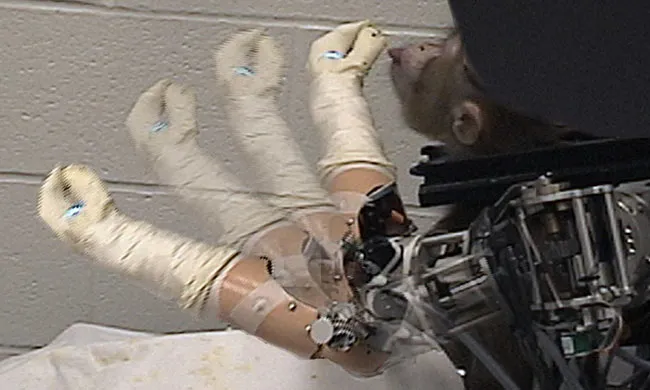
Brain-machine interfaces — devices that let users control electronics with their minds — have long enabled paralyzed individuals to perform everyday tasks such as sending e-mails and playing video games. But the problem with such interfaces is that they tend to lack the feeling of movement that typically goes along with these activities.
In a new study, researchers used robots to add this missing sensory input, and they’ve found it allows monkeys move a cursor across a screen more quickly and accurately.
"A lot of patients that are motor-disabled might have partial sensory feedback," said Nicholas Hatsopoulos, professor of neuroscience at the University of Chicago. "That got us thinking that maybe we could use this natural form of feedback withwearable robots to provide that kind of feedback."
To benefit from this solution, a paralyzed patient must have retained some residual sensory information from the limbs despite the loss of motor function – a common occurrence, especially in patients with ALS, locked-in syndrome, or incomplete spinal cord injury.
To test their theory, the researchers equipped two rhesus macaques monkeys with robotic sleeves that fit over the animals’ arms. The monkeys then performed the task of moving a cursor across a screen, first by simply using their eyes and next by using the added motion of theirrobotic arm.
“A wearable robot arm was used to move the monkey's arm to follow the cursor so that they ‘felt’ the position and motion of the cursor with their arm,” Hatsopoulos told TechNewsDaily. “We measured the time it took the monkey to reach a target with the cursor … [and] the straightness of the path taken by the cursor.”
The result: Using the added robotic arm, the monkeys were 40 percent faster and the cursor path was 40 percent straighter.
Get the world’s most fascinating discoveries delivered straight to your inbox.
The hope is that these wearable robots could be used for those suffering from paralysis, the researchers say.
“Signals from the brain could be used to move the wearable robot so that the human patient could interact with the outside world, and at the same time provide kinesthetic feedback to the patient,” Hatsopoulos said.
The findings were detailed in the Dec. 15 issue of the Journal of Neuroscience.
