













Mars crater is 'chock-full' of opal gemstones, hinting at widespread water and possible microbial life
Mysterious "halos" of rock surrounding cracks in a Martian crater may be made of water-rich opal gemstones, a new study suggests.

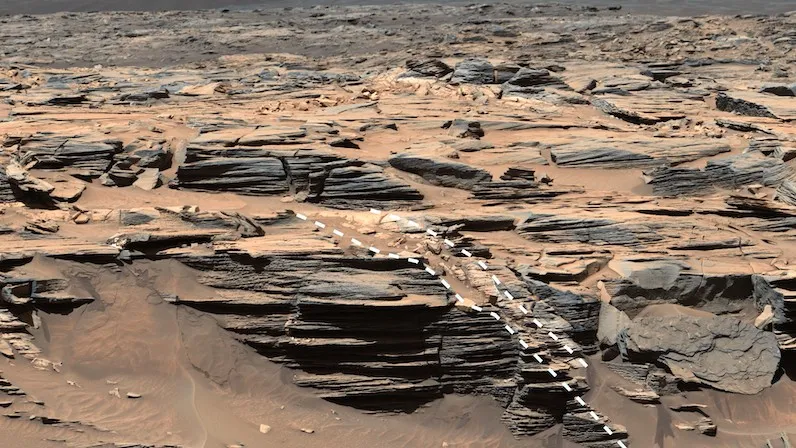
An ancient, dried-up lake bed on Mars may be teeming with opal gemstones, new data from NASA's Mars Curiosity rover suggests.
Beyond giving the cracked surface of Mars' Gale Crater a semiprecious glint, these opals could be evidence that water and rock have been interacting beneath the Martian surface much more recently than was previously thought, improving the prospects that microbial life once lived there, according to a study published Dec. 19 in the Journal of Geophysical Research: Planets.
Scientists often focus on water when searching for signs of extraterrestrial life because it's critical for life as we know it. But because water no longer flows on Mars, scientists must hunt for geological signs of the water that once existed there. These signs are present in the Red Planet's rocks and soil, where certain minerals and structures form only where rock and water have interacted.
Researchers spotted one such sign in the past few years around fractures in the Martian surface. Surrounding some of these fractures are "halos" of lighter-colored rock, which researchers found are likely rich in opal. For opal to form, silica-rich rocks must interact with water.
Now, researchers have dug into the Curiosity rover's vast archive of images and found that these opal-rich halos aren't isolated. Rather, they appear to exist all over Gale Crater, a 96-mile-wide (154 kilometers wide) ancient lake bed that Curiosity has explored since its mission began in 2012.
"Our new analysis of archival data showed striking similarity between all of the fracture halos we've observed much later in the mission," lead study author Travis Gabriel, a research physicist at the U.S. Geological Survey, said in a statement. "Seeing that these fracture networks were so widespread and likely chock-full of opal was incredible."
Gabriel and his colleagues were studying old images from Curiosity's traverse around Gale Crater and noticed, in an image taken much earlier in the mission, a light halo of rock surrounding a fracture. That halo looked almost exactly like halos found more recently. Data from Curiosity's ChemCam instrument, which analyzes rocks using images and spectrometry, showed that those recently studied light rocks likely contained silica-rich opals.
Get the world’s most fascinating discoveries delivered straight to your inbox.
To confirm the chemistry of those rocks, Gabriel's team ran an additional analysis on another set of fracture halos in a different location within the crater called the Lubango drill site. Here, the team used Curiosity's Dynamic Albedo of Neutrons (DAN) instrument, which measures neutrons that are knocked off the Martian surface by cosmic rays, high-energy particles from outside the solar system that constantly bombard Mars. These bouncing neutrons slow down in the presence of hydrogen, which is one of the main components of water. When DAN detects a higher proportion of slow-moving neutrons, that means there's more water-bearing rocks (like opal) in a given area.
Related stories
At the Lubango site, the DAN results confirmed that the lighter-colored halos on the ground do indeed contain opal, just like other sites around Gale Crater.
This data, along with the pictures of fracture halos from much earlier in the mission, tell researchers that water must have existed all over Gale Crater in more recent history.
"Given the widespread fracture networks discovered in Gale Crater, it's reasonable to expect that these potentially habitable subsurface conditions extended to many other regions of Gale Crater as well, and perhaps in other regions of Mars," Gabriel said. "These environments would have formed long after the ancient lakes in Gale Crater dried up."
This new realization that water must have survived in Gale Crater long after the lake evaporated means that life could have held on there a bit longer, the researchers said — possibly even into Mars' modern geological period, which began 2.9 billion years ago. (Mars is thought to be approximately 4.6 billion years old.)
These results add to a mountain of evidence that water was once widespread on Mars. To better understand the planet's watery past, the study authors propose the opal-rich fractures in Gale Crater as a new destination for collecting geological samples or for potential human exploration missions.

JoAnna Wendel is a freelance science writer living in Portland, Oregon. She mainly covers Earth and planetary science but also loves the ocean, invertebrates, lichen and moss. JoAnna's work has appeared in Eos, Smithsonian Magazine, Knowable Magazine, Popular Science and more. JoAnna is also a science cartoonist and has published comics with Gizmodo, NASA, Science News for Students and more. She graduated from the University of Oregon with a degree in general sciences because she couldn't decide on her favorite area of science. In her spare time, JoAnna likes to hike, read, paint, do crossword puzzles and hang out with her cat, Pancake.