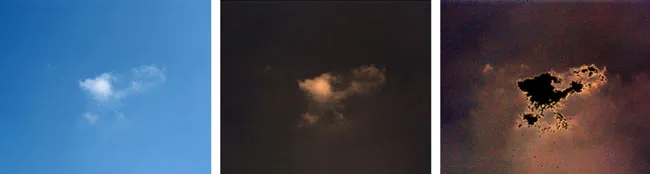
What appears as clear sky around a cloud as seen from the ground through a digital camera (left) actually has a twilight zone of light-reflecting particles around it (right). To see this, the blue light from the atmosphere in the original image is first subtracted (middle). The twilight zone is revealed after the darker parts of the image are enhanced (right).
(Image credit: Koren et al., Geophysical Research Letters)
An extensive and previously unknown “twilight zone” of particles in the atmosphere could complicate scientists’ efforts to determine how much the Earth's climate will warm in the future, a new study finds.
In addition to greenhouse gases, which absorb infrared radiation, or heat, emitted from Earth’s surface and send it back to the ground, cloud droplets and aerosols, such as dust and air pollutants, in the atmosphere also affect the planet’s temperature.
The exact overall effect of these two types of particles is still uncertain: while clouds block incoming solar radiation, water vapor also acts as a greenhouse gas, trapping heat like a blanket.
Now, recent satellite observations have found a zone of “in-between particles” in the air around clouds that was previously considered clear.
“The area around clouds has given us trouble,” said study team member Lorraine Remer of NASA’s Goddard Space Flight Center in Greenbelt, Md. “The instruments detected something there, but it didn’t match our understanding of what a cloud or an aerosol looked like. What we think we’re seeing is a transitional zone where clouds are beginning to form or are dying away, and where humidity causes dry particles to absorb water and get bigger.”
Scientists have been aware of an indistinct “halo” surrounding individual clouds, but the newly detected zone is much more extensive, taking up as much as 60 percent of the atmosphere previously labeled as cloud-free.
The previously unknown ingredient in the atmospheric mixture of particles will have to be factored into models that try to predict how the atmosphere influences the change of global temperatures.
Sign up for the Live Science daily newsletter now
Get the world’s most fascinating discoveries delivered straight to your inbox.
“The effects of this zone are not included in most computer models that estimate the impact of aerosols on climate,” said lead author Ilan Koren of the Weizmann Institute of Science, in Israel. “This could be one of the reasons why current measurements of this effect don’t match our model estimates.”
The study was published in the April 18 issue of the journal Geophysical Research Letters.
Andrea Thompson is an associate editor at Scientific American, where she covers sustainability, energy and the environment. Prior to that, she was a senior writer covering climate science at Climate Central and a reporter and editor at Live Science, where she primarily covered Earth science and the environment. She holds a graduate degree in science health and environmental reporting from New York University, as well as a bachelor of science and and masters of science in atmospheric chemistry from the Georgia Institute of Technology.