













Springtime Means Sun, Flowers and Smog from Abroad

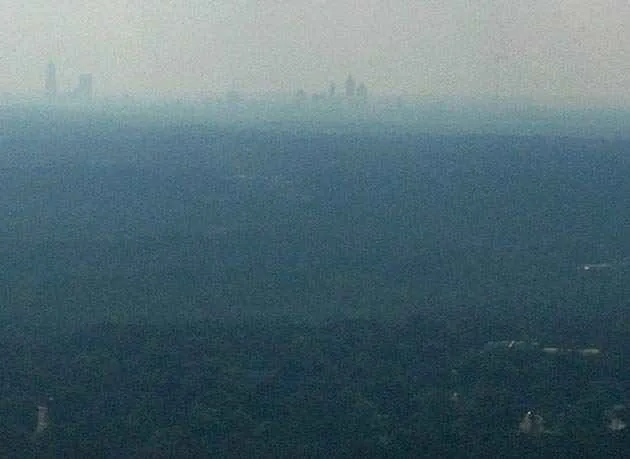
Spring brings sun, flowers and longer days. In the United States, it's also when more smog-making pollutants arrive after a long trek across the Pacific Ocean.
Large amounts of nitrogen oxides (NOx)—key chemicals in the production of ozone, or smog—reach North America in the spring, a new study indicates. The peak is in May.
The research, led by Yuhang Wang at the Georgia Institute of Technology, used data from aircraft about 3 to 4 miles over the western United States and north to Greenland. The observations are from different flight tracks each month, so firm comparisons month-to-month are not possible. But the broad picture is fairly clear.
In Februrary and March there was almost no NOx up there. A big lump appeared in April. By May, there were three regions with high concentration, Wang told LiveScience. The composition of the pollution and some computer modeling suggests it must have been in the atmosphere for some time, riding the prevailing winds rather than wafting up locally.
Likely from Asia
While the source has not been pinned down (it could be traveling from as far away as Europe) the likely culprit is Asia, where industrial pollution is on the rise as economic output soars.
"It's more likely to be coming from Asia than from Europe, but we don't know how much more likely," Wang said.
Get the world’s most fascinating discoveries delivered straight to your inbox.
Scientists already knew pollutants hitchhike air rides around the globe. U.S. pollution has been tracked to Europe. Dust is known to reach North America from both Africa and China.
"Finding this large amount of NOx traveling from across the Pacific is important because it will allow us to build better models so we can better understand how pollutants created in one region of the world are affecting the other regions," Wang said.
The research, supported by the National Science Foundation, is detailed in the journal Geophysical Research Letters.
May is bad
Detecting foreign pollution at Earth's surface is virtually impossible, because it gets lost in the shuffle of local bad air.
NOx comes primarily from cars, power plants and other industrial activity. With a recipe of NOx, water, carbon monoxide and a dash of ultraviolet light from the Sun, ozone is produced. Way up in the stratosphere, ozone is a good thing—it protects us from harmful UV rays. But down here, we call it smog. The stuff measured in Wang's study qualifies as "down here."
"You really don't need a lot of [NOx], but when you have a lot of it, it tends to produce ozone faster," Wang said.
May is a bad time for the globetrotting NOx to peak, Wang and his colleagues say.
"For the same amount of NOx," Wang explained, "ozone production is faster in May than April because there is more ultraviolet light and water vapor available in May."

Robert is an independent health and science journalist and writer based in Phoenix, Arizona. He is a former editor-in-chief of Live Science with over 20 years of experience as a reporter and editor. He has worked on websites such as Space.com and Tom's Guide, and is a contributor on Medium, covering how we age and how to optimize the mind and body through time. He has a journalism degree from Humboldt State University in California.