













Genetic Tricks of Parasites
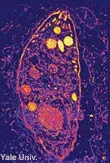
Parasites typically don’t have as many genes as their free-living relatives do. Life is simple because their hosts do the hard work of moving about, getting food, and avoiding predators.
Consider the nematodes (aka roundworms). The common free-living soil dweller Caenorhabditis elegans—which in 1998 became the first multicellular animal ever to have its genome decoded—has about 20,000 genes, whereas Brugia malayi, the parasite that causes the tropical disease filariasis, has just 11,500. Yet in the course of parasite evolution, genomes may need to grow before they can shrink.
Ralf J. Sommer and Christoph Dieterich of the Max-Planck Institute for Developmental Biology in Tübingen, Germany, along with fifteen colleagues, have sequenced the genome of Pristionchus pacificus, a nematode that invades the bodies of beetles but does not live off them. Instead, it waits in a state of suspended animation for its host beetle to die of natural causes before popping out and feeding on bacteria and fungi that grow on the carcass.
P. pacificus has about 23,500 genes, the team discovered, 17 percent more than C. elegans.
The ability to live both inside and outside a body, as P. pacificus does, is probably a stepping-stone on the evolutionary road to true parasitism, and it takes a big genome to get by in multiple habitats. Only once adaptively committed to spending its entire adult life within a host could a true parasite—perhaps a descendant of P. pacificus—pare down its DNA baggage.
The finding was detailed in the journal Nature Genetics.
Get the world’s most fascinating discoveries delivered straight to your inbox.