













Tiny Pterodactyl Fossil Found
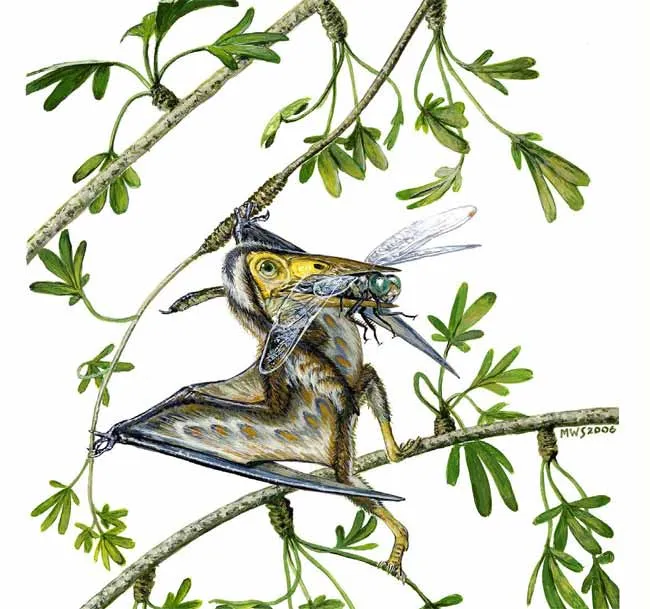
A pterodactyl so small that you could hold it in your hand glided in forest canopies in northeastern China where it feasted on insects 120 million years ago, new fossil remains suggest.
Paleontologists discovered the nearly complete skeleton of a toothless mini-pterodactyl, called Nemicolopterus crypticus, in the western part of China's Liaoning Province.
With a wingspan of nearly 10 inches (25 centimeters), this half-pint represents the smallest pterosaur, a group of winged reptiles that shared a common ancestor with dinosaurs and ruled the skies during the Jurassic period (206 million to 144 million years ago) and the subsequent Cretaceous period, which ended 65 million years ago.
"The animal is a very young animal, but it's not a hatchling that just left the egg," said researcher Alexander Kellner of the Department of Geology and Paleontology at the Museu Nacional/Universidade Federal do Rio de Janeiro. "Therefore it is the smallest pterosaur ever found."
Unlike its fish-eating relatives that lived near the water's edge, Nemicolopterus sported curved digits on its feet that would have helped the animal grasp tree branches. At that time, the researchers say, this inland environment was covered with gingko, conifers and other trees. The pterosaur's small size would also have helped it bound across the tree canopy, grabbing insects.
Its position in the evolutionary tree of pterosaurs suggests that a lineage of Nemicolopterus-like creatures led to all of the giant pterosaurs, including Quetzalcoatlus, which boasted a wingspan of more than 30 feet (10 meters).
"The general idea was at some point we had these very primitive pterosaurs — very low down on the evolutionary tree — that were living on insects," Kellner told LiveScience. "At some point pterosaurs learned to feed on fish."
Get the world’s most fascinating discoveries delivered straight to your inbox.
He added that the finding, detailed in the Feb. 12 issue of the Proceedings of the National Academy of Sciences, represents a new group of pterosaurs that could shed light on the evolution of all these flying reptiles.
- Image Gallery: Dinosaur Art
- Vote: Dinosaurs That Learned to Fly
- A Brief History of Dinosaurs
Jeanna Bryner is managing editor of Scientific American. Previously she was editor in chief of Live Science and, prior to that, an editor at Scholastic's Science World magazine. Bryner has an English degree from Salisbury University, a master's degree in biogeochemistry and environmental sciences from the University of Maryland and a graduate science journalism degree from New York University. She has worked as a biologist in Florida, where she monitored wetlands and did field surveys for endangered species, including the gorgeous Florida Scrub Jay. She also received an ocean sciences journalism fellowship from the Woods Hole Oceanographic Institution. She is a firm believer that science is for everyone and that just about everything can be viewed through the lens of science.