













Fossil Fin Sheds Light on Evolution of Limbs
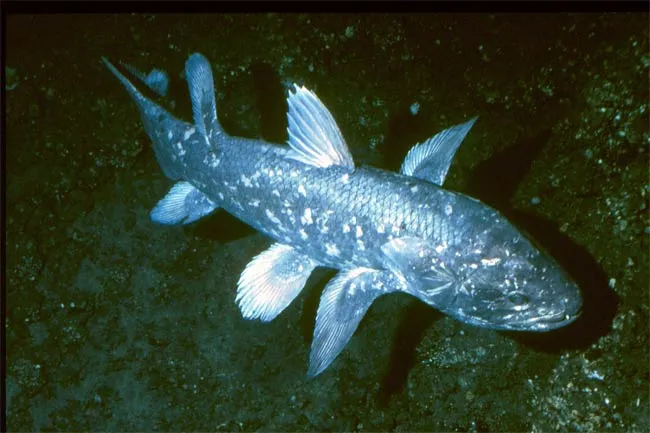
A 400 million-year-old fossilized fin from a strange-looking, primitive fish is shedding light on how fins evolved into limbs that enabled animals to walk on land.
The fossil fin comes from a coelacanth, a type of lobe-finned fish, and provides the only skeletal fin remains to date from the extinct relatives of today's living coelacanths. Scientists spotted the four-inch-long (10 centimeter-long) specimen at Beartooth Butte in northern Wyoming and have dubbed the fish Shoshinia arctopteryx after the Shoshine people and the Shoshone National Forest. When alive, the fish would have been about 18 to 24 inches (46 to 62 centimeters) in length.
The finding, detailed in the July/August issue of the journal Evolution & Development, shows the arrangement of bones within the fossil fin match the fin patterns found in primitive, living ray-finned fishes, such as sturgeons, paddlefishes and sharks.
Surprisingly, however, the patterns don't match the lobe-finned fish's living relative. Until now, scientists had assumed the living coelacanths and their relatives, the lungfish, served as accurate models of their ancestors dating back hundreds of millions of years ago.
"Two living fossils, coelacanths and lungfishes, are in fact not primitive," said lead author Matt Friedman of the University of Chicago. "They are specialized, and they are not particularly good models for understanding the origin of limbs."
In fact, living coelacanths are adapted for deep-water habitats off the coasts of Africa and Indonesia where they use a specialized organ in their noses to detect weak electrical signals from prey hidden in the mud along the seafloor.
Unlike fins on living coelacanths and lungfishes, the fossil fin has an asymmetrical pattern in which there are more bones on the front of the central shaft than the back. It has more in common with the anatomy of four-limbed vertebrates, called tetrapods, and even humans than it does with the anatomy of living coelacanths.
Get the world’s most fascinating discoveries delivered straight to your inbox.
The discovery of the new fossil means scientists can no longer make inferences about the evolution of limbs based on living coelacanths and lungfishes.
“To understand the developmental evolution of the limbs of tetrapods, we shouldn’t be looking at the fins of our nearest living fish relatives—lungfishes and coelacanths—because they’re far too specialized,” said co-author Michael Coates, a University of Chicago biologist.
- Top 10 Creatures of Cryptozoology
- Images: Freaky Fish
- Top 10 Useless Limbs (and Other Vestigial Organs)
Jeanna Bryner is managing editor of Scientific American. Previously she was editor in chief of Live Science and, prior to that, an editor at Scholastic's Science World magazine. Bryner has an English degree from Salisbury University, a master's degree in biogeochemistry and environmental sciences from the University of Maryland and a graduate science journalism degree from New York University. She has worked as a biologist in Florida, where she monitored wetlands and did field surveys for endangered species, including the gorgeous Florida Scrub Jay. She also received an ocean sciences journalism fellowship from the Woods Hole Oceanographic Institution. She is a firm believer that science is for everyone and that just about everything can be viewed through the lens of science.