













First Skull of Earliest Giant Pandas Found
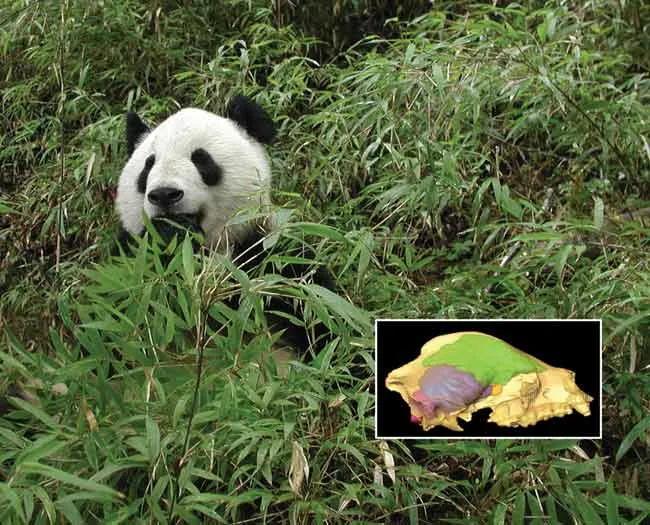
The dwarf ancestors of today’s giant pandas were already big-time bamboo munchers more than 2 million years ago, a new fossil skull reveals.
Unearthed from the Jinyin Cave in Guangxi, southern China, the fossil represents the first skull of the earliest giant pandas, Ailuropoda microta.
This so-called pygmy giant panda was half the size of its modern relatives and lived from about 2 million to 2.4 million years ago during the late Pliocene epoch in south China. There it roamed moist tropical forests alongside now-extinct creatures, such as the prehistoric elephant-like Stegodon, and the giant ape, Gigantopithecus, said study team member Russell Ciochon of the University of Iowa.
The skull and associated teeth showed features uniquely suited for bamboo-eating, matching those found in modern giant pandas (Ailuropoda melanoleuca).
“This shows that pandas are probably quite an ancient lineage that goes way back maybe 5 million years or more into the past,” Ciochon told LiveScience. “So pandas have been behaving like pandas for a very long time.”
Changzhu Jin of the Chinese Academy of Sciences and Ciochon, along with their colleagues, analyzed the skull using computed tomography (CT) scans.
The CT scans, seen in a 3-D animation, showed enlarged regions of the fossil skull where biting muscles attached, similar to those found in modern pandas to maximize bite force.
Get the world’s most fascinating discoveries delivered straight to your inbox.
Analysis of the teeth revealed the pygmy panda sported broad, flat teeth ideal for grinding tough bamboo along with small, pointy cusps for crushing the plant food. These dental adaptations were nearly identical to, though less complex than, modern-panda teeth, the scientists said.
“This whole specialized adaptation evolved quite early in the lineage, and it became perfected in the living form,” Ciochon said.
While the Pliocene was a time of global cooling and drying of the environment, it wasn’t until the Pleistocene epoch (1.8 million years ago to 10,000 years ago) that the land froze up, plunging the globe into the last ice age. So even during such climatic “turmoil,” pandas kept their bamboo-biting tools, the authors note in the report of their research published online this week in the Proceedings of the National Academy of Sciences.
- Video: Cute Panda Baby
- Images: The World’s Biggest Beasts
- Top 10 Species Success Stories
Jeanna Bryner is managing editor of Scientific American. Previously she was editor in chief of Live Science and, prior to that, an editor at Scholastic's Science World magazine. Bryner has an English degree from Salisbury University, a master's degree in biogeochemistry and environmental sciences from the University of Maryland and a graduate science journalism degree from New York University. She has worked as a biologist in Florida, where she monitored wetlands and did field surveys for endangered species, including the gorgeous Florida Scrub Jay. She also received an ocean sciences journalism fellowship from the Woods Hole Oceanographic Institution. She is a firm believer that science is for everyone and that just about everything can be viewed through the lens of science.