













Discovery Pushes Human Tool Use Back 800,000 Years

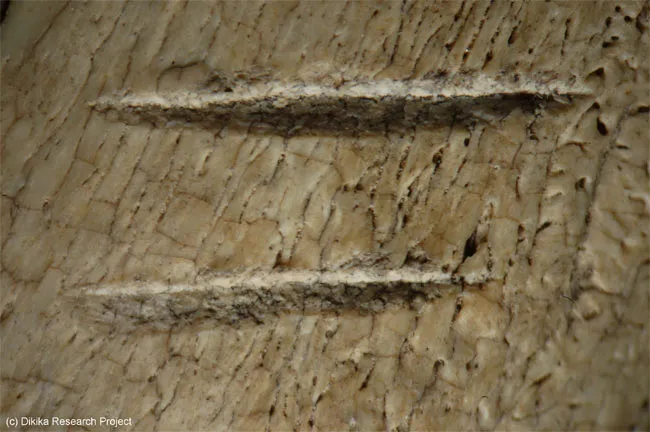
The timeline of early human evolution needs another revision with the discovery that human ancestors used tools 800,000 years earlier than previously realized.
The finding in Ethiopia, a pair of mammalian fossil bones marred by tool marks, pushes tool use back into the age of Australopithecus afarensis, an early human ancestor that lived in east Africa 3 million to 4 million years ago.
Archaeologists previously believed that early human ancestors, or hominins, started using tools 2.5 million years ago. That's when evidence shows one of the first Homo species, Homo habilis, began butchering meat with sharpened stones. (Our species, Homo sapiens, didn't show up until about 200,000 years ago.) But the new find is approximately 3.39 million years old, older than the famous Australopithecus fossil "Lucy," who lived near the find site 3.2 million years ago.
As far as scientists know, no other human ancestors lived in the area at that time, the researchers report today in the journal Nature, which means that Lucy and her relatives were likely responsible for slashing and crushing the bones to remove meat and marrow.
"It's never been shown before that Lucy used stone tools, and it's never been shown before that Lucy ate meat," said Shannon McPherron, an archaeologist at the Max Planck Institute for Evolutionary Anthropology, who discovered the new fossils. "We've moved back these critical behaviors."
Handy ancestors
Pinning down the emergence of stone tools and meat-eating is key for understanding our evolutionary history, the researchers said. Until now, the use of tools seemed linked to an increase in brain size in hominins, prompting theories that the extra calories from butchered meat fed our ancestors' growing brains. The realization that both meat-eating and tool use significantly predate the Homo genus could force another look at those theories.
Get the world’s most fascinating discoveries delivered straight to your inbox.
"There had long been an association between tool use and our genus," said David Braun, an archaeologist at the University of Cape Town, who was not involved in the research but penned a commentary on the findings in Nature. "That doesn't seem to be the case anymore."
McPherron discovered the fossils in January 2009 while working at a dig site in Dikika, a dry, dusty area in northeastern Ethiopia. Both are bone fragments, one from the right rib of a cow-sized hoofed mammal, and one from the leg of a similar mammal, this one the size of a goat. Immediately, McPherron noticed cut marks and crushed areas on the bones, as if something had sliced and hit them with a stone.
"We immediately knew that this was something important," McPherron told LiveScience.
The research team analyzed the fossils using a scanning electron microscope to get a close look at the bone surface. They also used a technique called energy dispersive X-ray spectrometry to determine the chemical characteristics of the fossil bones. They found that the marks were made before fossilization and that they matched the expected patterns for cut marks by a stone tool. One of the marks even had a tiny chip of stone embedded in it, likely all that remains of some ancient Australopithecine toolkit.
The researchers determined the age of the bones based on Dikika's geology. All of the fossils in this area are between two volcanic layers, one known to be 3.24 million years old and one known to be 3.42 million years old. By dating the layers of sediment between the volcanic deposits, the researchers determined that the fossils are probably 3.39 million years old.
Tool makers or just tool users?
The archaeologists haven't found any actual tools, so they can't know whether Australopithecus was making stone tools or just picking up conveniently shaped rocks off the ground. But it's likely that the tool use required some planning: Most of the stones found in Dikika from this time period are small pebbles, McPherron said. The nearest contemporary outcrops of large, sharp stones would likely have been several miles away.
"It suggests that early human ancestors were actually transporting rocks around the landscape pretty long distances, which means they could have been actively seeking out this resource," Braun said. "That kind of transport pattern is something we don't see amongst chimpanzees or other primates [today]."
Because no other evidence of tool use during this era has been found, using stones to butcher meat may have been a rare behavior among Australopithecus afarensis, McPherron said. The researchers plan to continue searching for hints of tool use and for evidence that Australopithecus made its own tools.
"It potentially opens up a new period in human evolution where our ancestors were experimenting with stone tools, laying the foundation for the development we see at around 2.5 million years ago," he said.
- Top 10 Mysteries of the First Humans
- Top 10 Things that Make Humans Special
- Top 10 Missing Links

Stephanie Pappas is a contributing writer for Live Science, covering topics ranging from geoscience to archaeology to the human brain and behavior. She was previously a senior writer for Live Science but is now a freelancer based in Denver, Colorado, and regularly contributes to Scientific American and The Monitor, the monthly magazine of the American Psychological Association. Stephanie received a bachelor's degree in psychology from the University of South Carolina and a graduate certificate in science communication from the University of California, Santa Cruz.