













Image Gallery: Ancient Monsters of the Sea

Monster diggers

A giant, marine reptile spanning some 40 feet (12 meters) in length has been officially named Pliosaurus funkei, scientists report in the Oct. 12, 2012 issue of the Norwegian Journal of Geology.
Getting underneath

In 2006, scientists unearthed two massive pliosaur skeletons in Svalbard, Norway, a string of islands halfway between Europe and the North Pole. The giant creatures, one of which was dubbed Predator X at the time, looked slightly different from other pliosaurs discovered in England and France over the last century and a half.
Flip it

The huge fossils had to be cast in plaster before being removed from the site.

Monster hunters camp

Here, the chilly camp where the researchers discovered the fossils.
A little breather

"They were the top predators of the sea," said study co-author Patrick Druckenmiller (right in photo), a paleontologist at the University of Alaska Museum. "They had teeth that would have made a T. rex whimper." Druckenmiller (right) analyzed the pliosaur specimens with colleagues Espen M. Knutsen and Jørn H. Hurum, both of the Natural History Museum, University of Oslo.
Killer instinct
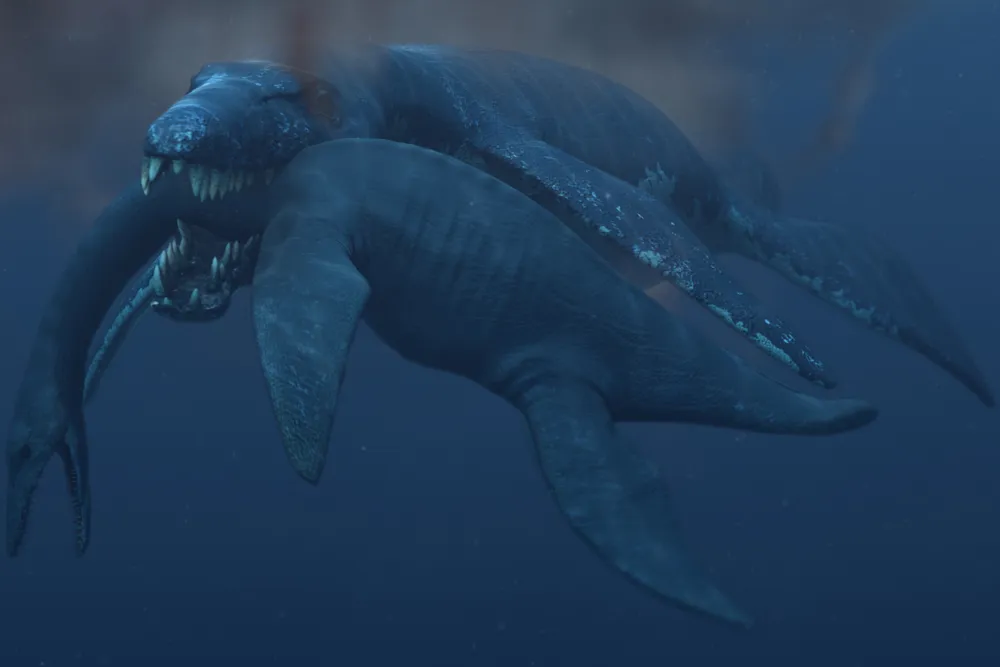
The new species likely lived about 145 million years ago and ate plesiosaurs, related long-necked, small-headed reptiles. Here the nearly 50-ton (45-tonne) pliosaur attacks a plesiosaur.
The end

Pliosaurus funkei had a bite four times as powerful as Tyrannosaurus rex; in this artist's conception, the powerful pliosaur crushes down on a plesiosaur with its 33,000-pound bite.
Get the world’s most fascinating discoveries delivered straight to your inbox.
Size definitely matters

The researchers estimate the creature was bigger than the largest living apex predator, the killer whale, which tops out at about 30 feet (9 meters) long. (Shown here in a size comparison with a killer whale, blue whale and human diver.)
Clean-up crew

The Pliosaurus funkei fossils were just two of nearly 40 specimens discovered at the Svalbard site. In the Oct. 12 issue of the Norwegian Journal of Geology, the authors also describe two new ichthyosaurs (dolphinlike reptiles), the longest-necked Jurassic-era plesiosaur on record, and several invertebrates. Here, an artist's interpretation of ichthyosaurs feeding on a carcass of a plesiosaur.
Quick catch

Artist's interpretation of the huge pliosaur catching a pterosaur.
Fair game

Artist's interpretation of "Predator X" catching a smaller plesiosaur.
