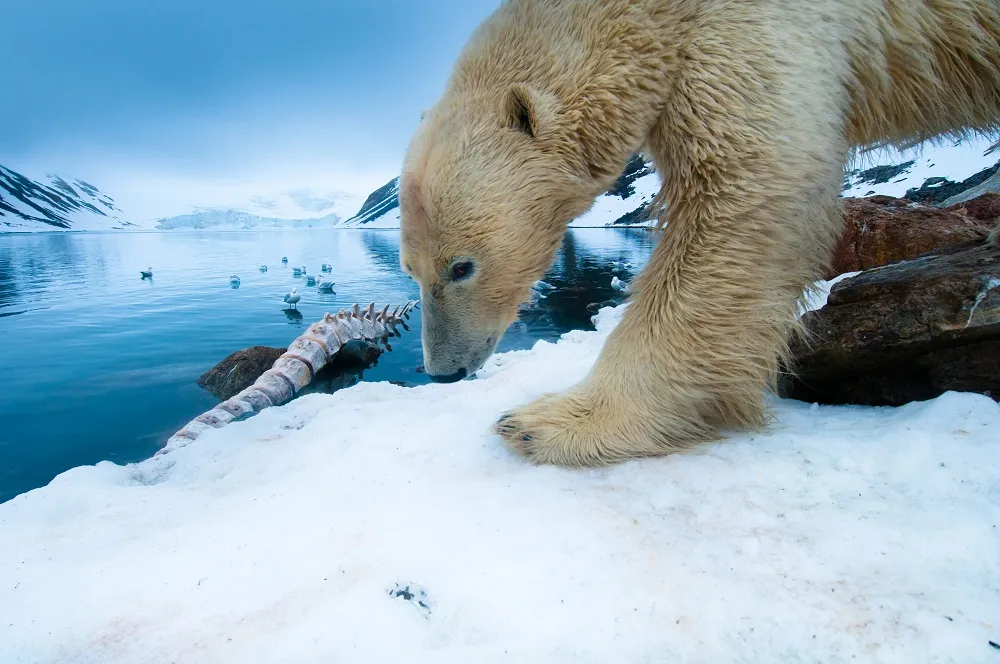
A large male polar bear returns to feed on a fin whale carcass. On land, where bears cannot hunt for seals, food is scarce and polar bears mainly depend on washed up marine mammals for food. Holmiabukta Bay, Northwestern Svalbard, Norway.
Polar bears have been chilling on the ice far longer than is generally thought, new research suggests, and they probably interbred with brown bears at one point after the two species separated.
The new German study contradicts data from a study published last July in the journal Current Biology that suggested polar bears separated from brown bears 150,000 years ago. The new study analyzed the bears' mitochondrial DNA, a special "additional genome" that lives in the cell's energy factories and is passed down only from the mother. The new study concludes that the bears became separate species closer to 600,000 years ago.
If the polar bears were only 150,000 years old, as suggested by the previous study, they would have had to evolve many specialized traits in a curiously brief time, the German researchers said.
"I've been long puzzled by the suggestion that the polar bears would have been such a miraculous and rapidly evolving species," Frank Hailer of the Senckenberg Nature Research Society in Frankfurt told LiveScience. "I had this lingering question: Is it really true?"
Nuclear problem solver
A polar bear mother and her cubs of the year rest on one of the few remaining piece of drift ice in the Barents Sea in late July, Northeastern Svalbard, Northern Europe.
Hailer and his colleagues looked at the polar bear's nuclear DNA, which comes from both parents and is much larger than the mitochondrial genome. [Fun Facts About Polar Bears]
They compared 9,000 base-pair sequences (the chemicals that make up the "rungs" of DNA's ladderlike molecule) from the nuclear DNA of 45 polar, brown and black bears. This comparison let the researchers build a family tree, with the idea that the greater the genetic differences between the species, the farther they were apart in evolutionary time. They were able to estimate when the polar bears and brown bears separated.
Sign up for the Live Science daily newsletter now
Get the world’s most fascinating discoveries delivered straight to your inbox.
"We found that polar bears are much older than we previously knew from other studies; their appearance dated to about 600,000 years ago," Hailer said. "That would make sense around that time for something like a polar bear to evolve, because Arctic habitats were much larger than they are today, so there would have been much larger habitats that would have been suitable for a species like a polar bear."
Adapting to environment
Female polar bear with her cub on a frozen lake near Cape Churchill, Canada.
The researchers say the mitochondrial DNA data could have come from a hybridization event between polar and brown bears 150,000 years ago during the last warm interglacial period. During that time, sea ice melted and polar bears took to the shores, where they came into contact with brown bears.
The researchers say this hybridization (similar to the hybrid "grolar" or "pizzly" bears seen in recent years in Canada) would have introduced the brown bear mitochondrial DNA into the polar bear population. If the DNA from the brown bears helped the polar bears survive the warm period, it's possible it could have easily spread throughout the population.
It seems "the polar bear population at the time they hybridized with brown bears was very small," Hailer said. "The impact of hybridization was very large, so the piece of mitochondrial DNA that came from brown bears to polar bears replaced all the original polar bear mitochondrial DNA."
This study appears in the April 20 issue of the journal Science.
You can follow LiveScience staff writer Jennifer Welsh on Twitter, on Google+ or on Facebook. Follow LiveScience for the latest in science news and discoveries on Twitter and on Facebook.
Jennifer Welsh is a Connecticut-based science writer and editor and a regular contributor to Live Science. She also has several years of bench work in cancer research and anti-viral drug discovery under her belt. She has previously written for Science News, VerywellHealth, The Scientist, Discover Magazine, WIRED Science, and Business Insider.