
-
 Can people catch infections from plants?
Life's Little Mysteries Catching diseases from plants may not just be the domain of science fiction.
Life's Little Mysteries -
 Why do kids eat their boogers?
There may be something more than just a bad habit behind this behavior.
3 Commentshuman-behavior -
 Can a turtle tuck its head all the way inside its shell?
Turtle shells evolved over the course of 300 million years, but self-defense wasn't the initial driver, researchers think.
turtles-tortoises -
 What is the world's slowest animal?
What does survival look like for animals who live in the slow lane?
animals -
 What's the longest lightning bolt ever recorded?
Lightning is one of the greatest natural forces on our planet. New mapping tools are revealing just how big it is.
weather -
 People can be identified by their breathing patterns with 97% accuracy
Breathing patterns among humans are so unique that they can work as an identification tool, scientists report. They propose someday using breath as a way to diagnose disease.
health -
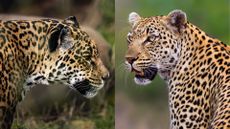 What's the difference between a leopard and a jaguar?
Look closely at the spots to tell leopards from jaguars: there's a subtle clue.
2 Commentscats -
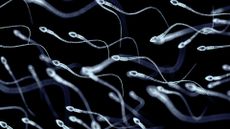 How long can human sperm survive?
It's a myth that sperm die upon contact with oxygen. In fact, their resilience might surprise you.
sex -
 Do pandas eat anything besides bamboo?
Pandas are descended from carnivores. Why do they eat an (almost) exclusively vegan diet?
bears -
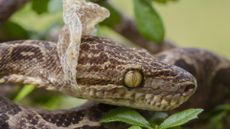 Why do snakes shed their skin?
It's a story that involves scales, sloughs — and spectacles.
snakes -
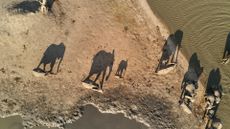 Do 'elephant graveyards' really exist?
Stories of vast graveyards where elephants go to die only scratch the surface of the fascinating death-related behaviors in these mammals.
elephants -
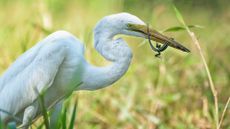 Are birds reptiles?
If you're wondering whether birds are reptiles, know this: The reptile family tree is more varied and diverse than you might realize.
2 Commentsbirds -
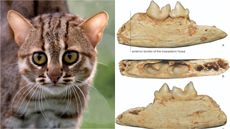 World's tiniest cat was a palm-sized tiddler that lived in China 300,000 years ago
Scientists identified the tiny species of cat from a fossilized jawbone, which could date back as far as 300,000 years ago.
extinct-species -
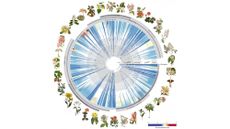 What is the 'tree of life'?
The tree of life maps out the relationships between all living things, and it's in constant flux.
evolution -
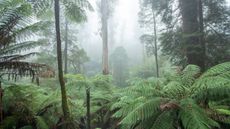 Rainforest of super trees descended from lost supercontinent Gondwana being created in Australia
Project seeks to protect ancient tree lineages that have survived from a time before Earth’s continents broke apart.
plants -
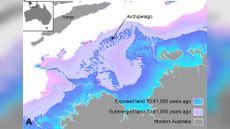 Scientists map the lost 'Atlantis' continent that lies off Australia
A new simulation reveals how Australia's first inhabitants migrated across Sahul, before it became modern-day Australia.
archaeology -
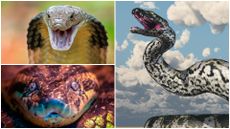 The biggest snake in the world (and 10 other giant serpents)
From Titanoboa and Vasuki — prehistoric snakes as long as a Tyrannosaurus rex — to modern-day pythons and boa constrictors that can swallow humans whole, these are the biggest, heaviest and longest snakes to have ever lived on Earth.
snakes -
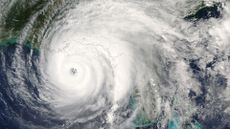 AI-powered 'digital twin' of Earth could make weather predictions at super speeds
An AI-driven supercomputer dubbed Earth's 'digital twin' could help us avoid the worst impacts of climate catastrophes headed our way.
climate-change -
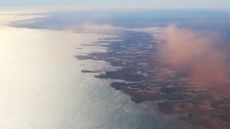 Drowned land off Australia was an Aboriginal hotspot in last ice age, 4,000 stone artifacts reveal
The landscape features in the dreamtime stories of Australia's Indigenous people.
archaeology -
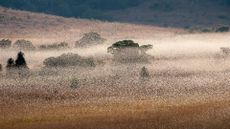 Giant, synchronized swarms of locusts may become more common with climate change
Locust swarms can arise from several locations at once. Research has linked these dramatic events to bouts of heavy rain and wind — and that's not good news under climate change.
climate-change -
Lost 'Atlantis' continent off Australia may have been home for half a million humans 70,000 years ago
Sonar mapping revealed signs of rivers and freshwater lakes across a now-sunken landscape almost twice the size of the UK, where humans could once have thrived.
planet-earth -
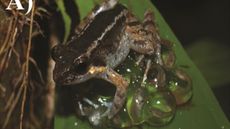 World's tiniest fanged frog with males that 'hug' their babies discovered
Researchers found a new species of fanged frog when they noticed clutches of eggs laid on leaves and mossy boulders unusually far above water.
amphibians -
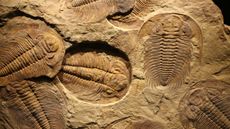 Poisonous gas wave may have snuffed out half of all sea life in Earth's 1st mass extinction
About 510 million years ago, a deadly combination of low oxygen and surging hydrogen sulfide may have been what decimated 45% of all ocean life.
archaeology -
 What is Point Nemo, the remote, watery satellite graveyard where the ISS will go to die?
In the furthest, deepest reaches of the ocean, there is a watery graveyard where the world's satellites and space stations go to rest.
rivers-oceans


