

-
 New semiconductor could allow classical and quantum computing on the same chip, thanks to superconductivity breakthrough
Researchers believe they can fit 25 million Josephson junctions — a useful component for quantum computing — on one two-inch wafer with this approach.
quantum -
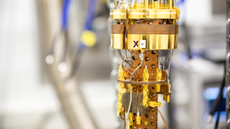 Exotic 'time crystals' could be used as memory in quantum computers, promising research finds
Experiments show that a time crystal based on magnons can interact with mechanical waves without being destroyed.
quantum -
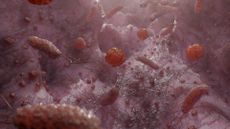 'Truly miraculous': Common gut microbe shows promise as fatty liver disease treatment
Researchers shed light on the "dark matter" of the gut, revealing a species of fungus that could potentially help counter fatty liver disease. The research is in its early days, though.
4 Commentshealth -
 AI analysis of 100 hours of real conversations — and the brain activity underpinning them — reveals how humans understand language
An AI model trained on dozens of hours of real-world conversation accurately predicts human brain activity and shows that features of language structure emerge without being coded in.
neuroscience -
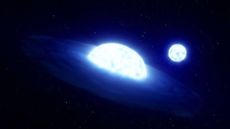 'Vampire' stars that bleed their companions dry may have a hidden accomplice, new study reveals
Scientists suspect that type-Be 'vampire' stars grow by preying on their smaller companions. New research suggests there may be an important third player in these systems.
physics-mathematics -
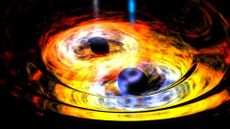 Newly discovered black hole 'speed limit' hints at new laws of physics
When supermassive black holes barrel toward collision, they can reach speeds of up to 1/10th the speed of light, new research suggests.
physics-mathematics -
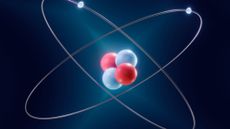 Scientists tried to solve the mystery of the helium nucleus — and ended up more confused than ever
Helium is the simplest element in the periodic table with more than one particle in its nucleus, yet state of the art theory and experiments on it don't add up.
particle-physics -
 Metformin cuts risk of long COVID by 40% in patients with obesity, trial suggests
A new study shows metformin can diminish risk of developing long COVID by more than 40% in overweight and obese patients.
coronavirus -
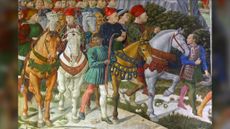 Medici family's famous hunting grounds may have killed them, report suggests
At least one Medici was plagued by a deadly strain of malaria, analysis of organ tissue from the Medici family tomb reveals.
archaeology -
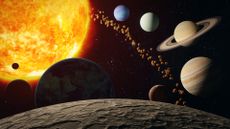 Scientists discover secret 'symmetries' that protect Earth from the chaos of space
A new analysis of chaos in the solar system reveals how planetary collisions are avoided over billions of years.
cosmology -
 Even mild concussions can 'rewire' the brain, possibly causing long-term symptoms
After a mild concussion, parts of the brain can become "hyperconnected," and this may contribute to patients' long-lasting symptoms.
neuroscience -
 Scientists create 'slits in time' in mind-bending physics experiment
Researchers replicated the classic double slit experiment using lasers, but their slits are in time not space.
particle-physics -
 Most methods for squashing conspiracy theories don't work, study finds. Here's what does.
A systematic review of conspiracy theory interventions shows that most traditional approaches have little impact, but certain alternatives show promise.
conspiracies-paranormal -
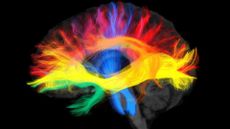 Your native language may shape the wiring of your brain
The connections between different regions of the brain responsible for language processing depend on which language you grew up with.
neuroscience


