The brain of one of the oldest Australopithecus individuals ever found was a little bit ape-like and a little bit human.
In a new study, researchers scanned the interior of a very rare, nearly complete skull of this ancient hominin ancestor. Hominins include modern and extinct humans and all their direct ancestors, including Australopithecus, which lived between about 4 million and 2 million years ago in Africa, and early humans of the genus Homo would eventually evolve from Australopithecus ancestors.
Beaudet and her colleagues used micro-computed tomography (micro-CT), a very sensitive version of the same sort of technology a surgeon might use to scan a bum knee. With this tool,the researchers reconstructed the interior of the skull of a very old Australopithecus.
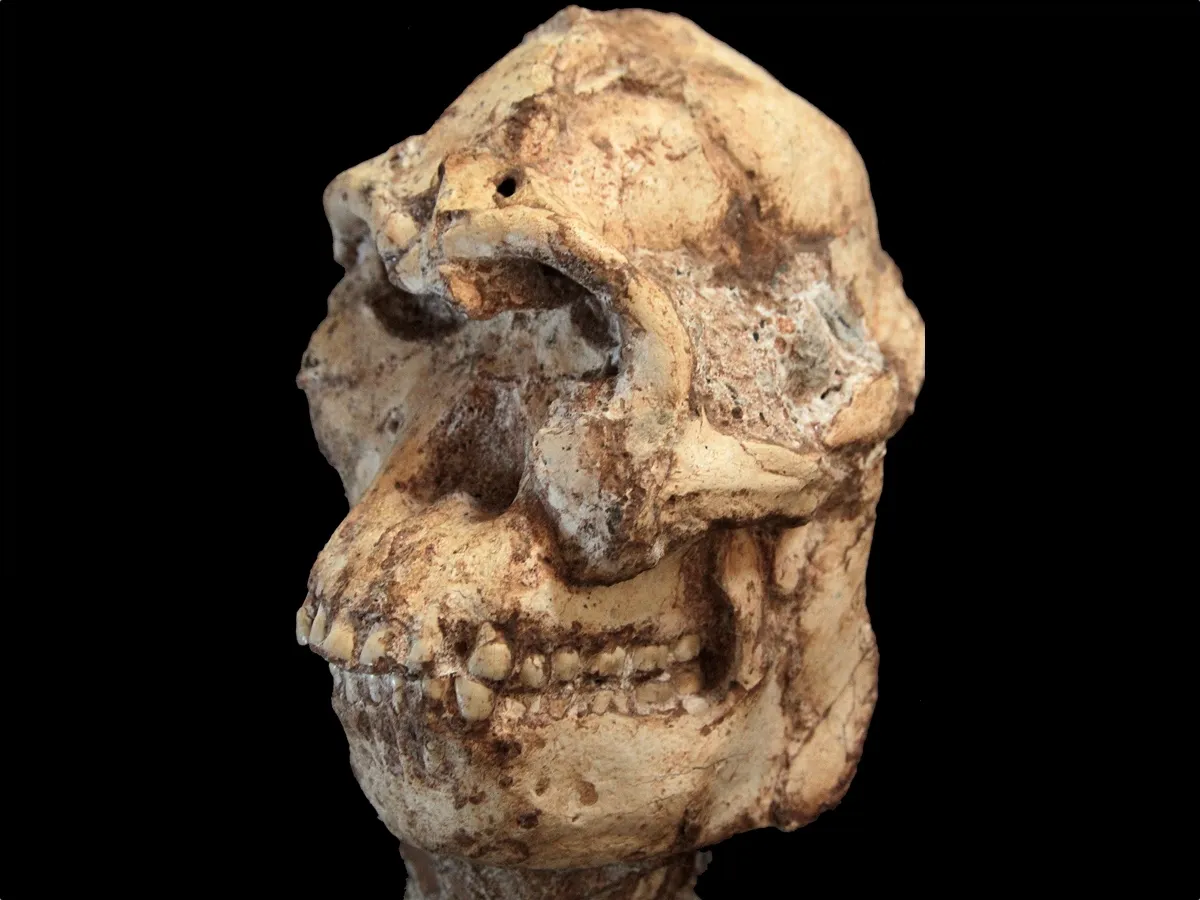
The skull belongs to a fossil dubbed "Little Foot," first found two decades ago in Sterkfontein Caves near Johannesburg. At 3.67 million years old, Little Foot is among the oldest of any Australopithecus ever found, and its skull is nearly intact. The fossil's discoverers think it may belong to an entirely new Australopithecus species, Live Science reported.
With micro-CT, the research team could see very fine imprints of where the brain once lay against Little Foot's skull, including a record of the paths of veins and arteries, Beaudet told Live Science. Using the skull to infer brain shape in this way is called making an endocast.
Virtual rendering of the brain endocast of "Little Foot," possibly a new species of Australopithecus.
(Image credit: M. Lotter and R.J. Clarke/Wits University)
"I was expecting something quite similar to the other endocasts we knew from Australopithecus, but Little Foot turned out to be a bit different, in accordance with its great age," Beaudet said.
Sign up for the Live Science daily newsletter now
Get the world’s most fascinating discoveries delivered straight to your inbox.
Today's chimpanzees and humans share an ancestor older than Little Foot: some long-lost ape that gave rise to both lineages. Little Foot's brain looks a lot like that predicted ancestor's should look, Beaudet said, more ape-like than human. Little Foot's visual cortex, in particular, took up a greater proportion of its brain than that area does in the human brain.
In humans, Beaudet said, the visual cortex has been pushed aside to accommodate the expansion of the parietal cortex, an area involved in complex activities like toolmaking.
Changing brains
Little Foot's brain was asymmetrical, with slightly differing protrusions on each side, the researchers found. This is a feature shared with both humans and apes, and it probably indicates that Australopithecus had brain lateralization, meaning that the two sides of its brain performed different functions. The finding means that brain lateralization evolved very early in the primate lineage. [Homo Naledi in Photos: Images of the Small-Brained Human Relative]
Little Foot's brain was different from later Australopithecus specimens, Beaudet said. The visual cortex, in particular, was larger compared to later Australopithecus brains. These differences hint that brain evolution was a piecemeal process, occurring in fits and starts across the brain. .
Stephanie Pappas is a contributing writer for Live Science, covering topics ranging from geoscience to archaeology to the human brain and behavior. She was previously a senior writer for Live Science but is now a freelancer based in Denver, Colorado, and regularly contributes to Scientific American and The Monitor, the monthly magazine of the American Psychological Association. Stephanie received a bachelor's degree in psychology from the University of South Carolina and a graduate certificate in science communication from the University of California, Santa Cruz.