













Key to All Optical Illusions Discovered
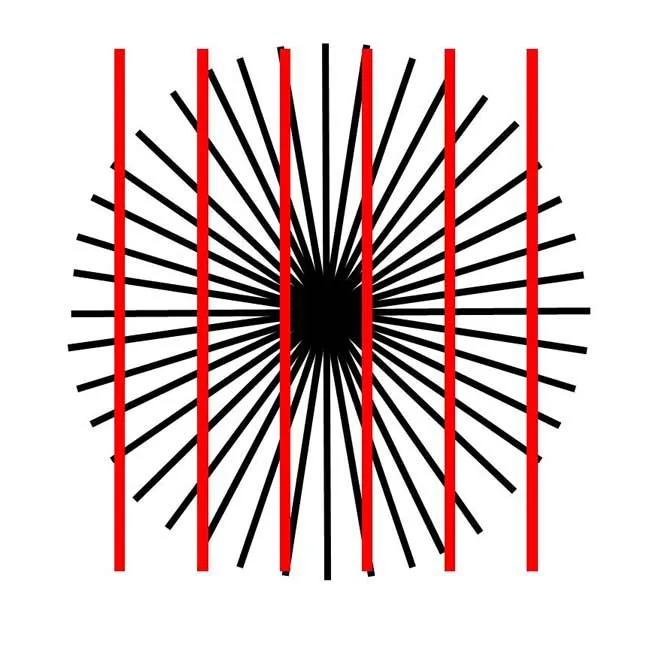
Humans can see into the future, says a cognitive scientist. It's nothing like the alleged predictive powers of Nostradamus, but we do get a glimpse of events one-tenth of a second before they occur.
And the mechanism behind that can also explain why we are tricked by optical illusions.
Researcher Mark Changizi of Rensselaer Polytechnic Institute in New York says it starts with a neural lag that most everyone experiences while awake. When light hits your retina, about one-tenth of a second goes by before the brain translates the signal into a visual perception of the world.
Scientists already knew about the lag, yet they have debated over exactly how we compensate, with one school of thought proposing our motor system somehow modifies our movements to offset the delay.
Changizi now says it's our visual system that has evolved to compensate for neural delays, generating images of what will occur one-tenth of a second into the future. That foresight keeps our view of the world in the present. It gives you enough heads up to catch a fly ball (instead of getting socked in the face) and maneuver smoothly through a crowd. His research on this topic is detailed in the May/June issue of the journal Cognitive Science,
Explaining illusions
That same seer ability can explain a range of optical illusions, Changizi found.
Get the world’s most fascinating discoveries delivered straight to your inbox.
"Illusions occur when our brains attempt to perceive the future, and those perceptions don't match reality," Changizi said.
Here's how the foresight theory could explain the most common visual illusions — geometric illusions that involve shapes: Something called the Hering illusion, for instance, looks like bike spokes around a central point, with vertical lines on either side of this central, so-called vanishing point. The illusion tricks us into thinking we are moving forward, and thus, switches on our future-seeing abilities. Since we aren't actually moving and the figure is static, we misperceive the straight lines as curved ones.
"Evolution has seen to it that geometric drawings like this elicit in us premonitions of the near future,” Changizi said. "The converging lines toward a vanishing point (the spokes) are cues that trick our brains into thinking we are moving forward — as we would in the real world, where the door frame (a pair of vertical lines) seems to bow out as we move through it — and we try to perceive what that world will look like in the next instant."
Grand unified theory
In real life, when you are moving forward, it's not just the shape of objects that changes, he explained. Other variables, such as the angular size (how much of your visual field the object takes up), speed and contrast between the object and background, will also change.
For instance, if two objects are about the same distance in front of you, and you move toward one of the objects, that object will speed up more in the next moment, appear larger, have lower contrast (because something that is moving faster gets more blurred), and literally get nearer to you compared with the other object.
Changizi realized the same future-seeing process could explain several other types of illusions. In what he refers to as a "grand unified theory," Changizi organized 50 kinds of illusions into a matrix of 28 categories. The results can successfully predict how certain variables, such as proximity to the central point or size, will be perceived.
Changizi says that finding a theory that works for so many different classes of illusions is "a theorist's dream."
Most other ideas put forth to explain illusions have explained one or just a few types, he said. The theory is "a big new player in the debate about the origins of illusions," Changizi told LiveScience. "All I'm hoping for is that it becomes a giant gorilla on the block that can take some punches."
- Video: How to Time Travel
- Study Reveals How Magic Works
- Top 10 Mysteries of the Mind
Jeanna Bryner is managing editor of Scientific American. Previously she was editor in chief of Live Science and, prior to that, an editor at Scholastic's Science World magazine. Bryner has an English degree from Salisbury University, a master's degree in biogeochemistry and environmental sciences from the University of Maryland and a graduate science journalism degree from New York University. She has worked as a biologist in Florida, where she monitored wetlands and did field surveys for endangered species, including the gorgeous Florida Scrub Jay. She also received an ocean sciences journalism fellowship from the Woods Hole Oceanographic Institution. She is a firm believer that science is for everyone and that just about everything can be viewed through the lens of science.