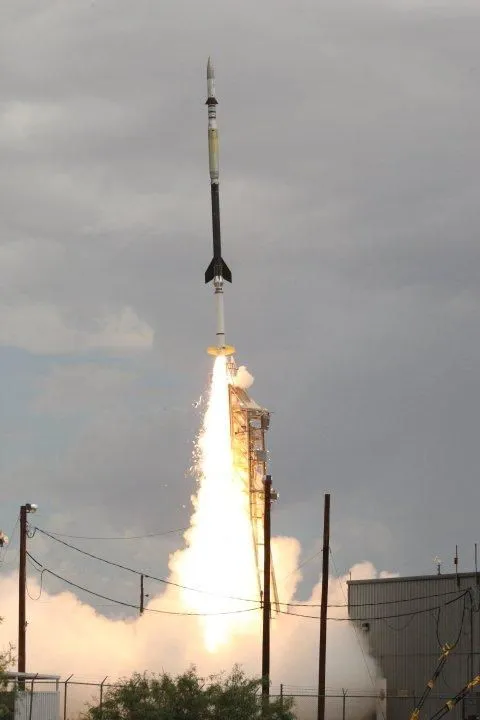
The High resolution Coronal Imager (Hi-C) was launched on a NASA Black Brant IX two-stage rocket from White Sands Missile Range in New Mexico July 11, 2012. The experiment reached a maximum velocity of Mach 7 and max altitude of 264 km. The experiment collected 345 seconds of EUV science images. Image released Jan. 23, 2013.
While many NASA space telescopes soar in orbit for years, the agency's diminutive Hi-C telescope tasted space for just 300 seconds, but it was enough time to see through the sun's secretive atmosphere.
Designed to observe the hottest part of the sun — its corona — the small High-Resolution Coronal Imager (Hi-C) launched on a suborbital rocket that fell back to Earth without circling the planet even once. The experiment revealed never-before-seen "magnetic braids" of plasma roiling in the sun's outer layers, NASA announced today (Jan. 23)
The Hi-C instrument on the integration table at the Harvard-Smithsonian Center for Astrophysics. Image released Jan. 23, 2013.
(Image credit: NASA/MSFC)
"300 seconds of data may not seem like a lot to some, but it's actually a fair amount of data, in particular for an active region" of the sun, Jonathan Cirtain, Hi-C mission principal investigator at NASA's Marshall Space Flight Center in Huntsville, Ala., said during a NASA press conference today.
The solar telescope snapped a total of 165 photos during its mission, which lasted 10 minutes from launch to its parachute landing.
Hi-C launched from White Sands Missile Range in New Mexico atop a sounding rocket in July 2012. The mission cost a total of $5 million — a relative bargain for a NASA space mission, scientists said. The experiment was part of NASA's Sounding Rocket Program, which launches about 20 unmanned suborbital research projects every year. [NASA's Hi-C Photos: Best View Ever of Sun's Corona]
"This mission exemplifies the three pillars of the [sounding rocket] program: world-class science, a breakthrough technology demonstration, and the training of the next generation of space scientists," said Jeff Newmark, a Sounding Rocket Program scientist at NASA Headquarters in Washington, D.C.
NASA's High-resolution Coronal Imager (Hi-C) capture over 50 16-Megapixel images of the 1.5 million-degree solar corona. The large image is the full frame image and the smaller images along the top and sides are sub fields of the image. The upper left corner image is from the Atmospheric Imaging Assembly on the Solar Dynamics Observatory and the box in this image shows the Hi-C field of view. Released Jan. 23, 2013.
(Image credit: Dr. Amy Winebarger, MSFC/NASA)
Hi-C used a modified Cassegrain telescope with a 9.5-inch-diameter mirror to take close-up images of an active region on the sun, achieving a resolution equivalent to sighting a dime from 10 miles away.
Sign up for the Live Science daily newsletter now
Get the world’s most fascinating discoveries delivered straight to your inbox.
While NASA already has telescopes in orbit constantly monitoring the whole surface of the sun, such as the Solar Dynamics Observatory (SDO), the Hi-C mission allowed scientists to focus in on a smaller region than SDO is able to.
"SDO has a global view of the sun," Newmark said. "What this research does is act like a microscope and it zooms in on the real fine structure that's never been seen before."
The next step, the researchers said, is to design a follow-up instrument to take advantage of the new telescope technology tested out by Hi-C, to observe for a longer period of time on an orbital mission.
"Now we've proven it exists, so now we can go study it," said Karel Schrijver, a senior fellow at the Lockheed Martin Advanced Technology Center in Palo Alto, Calif., where the instrument was built.
Clara has a bachelor's degree in astronomy and physics from Wesleyan University, and a graduate certificate in science writing from the University of California, Santa Cruz. She has written for both Space.com and Live Science.