













High-Tech Glitter to Create Flexible Solar Panels

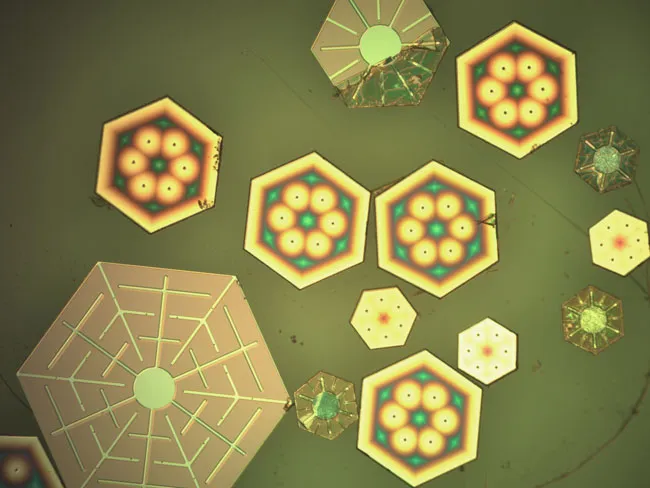
Researchers have unveiled super-small solar cells no bigger than the pieces of glitter on your holiday ornaments and cards. These highly efficient photovoltaics could be game-changers in the burgeoning field of solar power, allowing arrays of microcells to be placed on bendable or curved surfaces and even woven into clothing.
Unlike the conventional, rigid solar cells deployed as flat panels on rooftops, for instance, the new miniscule cells could be encapsulated in flexible plastic and made to fit virtually any object.
"With this technology, one can envision ubiquitous [solar-powered] devices," said Greg Nielson, lead investigator at Sandia National Laboratories in New Mexico.
The prototype versions of the microcells are stored in vials of isopropyl alcohol, and, in keeping with the winter season, if you shake the vials "it does look like a snow globe with flakes swirling around inside," said Nielson, as the tiny, shiny contraptions catch the light.
How it works
Like most snowflakes, the microcells are six-sided to maximize available space by interlocking like honeycomb, or the panels on a soccer ball.
In the lab, these hexagonal microcells have achieved photovoltaic efficiencies of about 15 percent, denoting the percentage of light shone on them that is converted into harvestable electricity. High-end commercial-grade solar cells can reap about 20 percent currently, though Nielson thinks the microcells can more than match this.
Get the world’s most fascinating discoveries delivered straight to your inbox.
The microcells, made of the crystalline silicon found in standard solar cells, have already demonstrated higher efficiencies than so-called thin film solar technologies presently being explored that use other, cheaper materials, such as cadmium telluride.
Instead of converting a whole wafer of silicon into a typical solar cell, the Sandia team's manufacturing method yields thousands of microcells on thin slices of the wafer, like when making a microchip for a computer.
This technique leaves plenty of raw material to produce more microcells and requires 100 times less silicon than for conventional, thicker solar cells, said Nielson. The microcells themselves range in size from 0.00098 to 0.039 inches (25 micrometers to one millimeter) across and from 0.00055 to 0.00079 (14 to 20 micrometers) thick. (For reference, a human hair is about 0.0028 inches (70 micrometers) in width.)
Although the microcell manufacturing process is complex, the material and photovoltaic efficiency of the microcells should still result in reduced costs compared to today's solar power, Nielson said.
"It's great and important that we reduce cost potential by going this way," Nelson told LiveScience, "but what's more exciting is what you can do with these cells that you can't with anything else."
Many possibilities
Making the microcells ultra-thin opens up many possibilities, the researchers say.
"You don't have large-area wafers that are rigid and don't bend," said Nelson. This means the microcells are conformable and can be tailor-fitted to objects from building facades to sloping car roofs, much like how smaller-sized tiles can be mortared to make a curved mosaic.
The tiny solar cells can also be embedded in plastic sheets. The resulting photovoltaic material might then be crafted into tents or store awnings, Nielson suggested.
People could also wear miniature solar cells woven into the fabric of their clothing to power personal electronic devices. High photovoltaic efficiency is very important in this case because the limited dimensions of the human body offer relatively little space to capture sunshine, said Nielson.
- 10 Ways to Green Your Home
- Top 10 Emerging Environmental Technologies
- Powerful Ideas: Spray-On Solar Cells
