













Mystery of the Sargasso Sea Solved

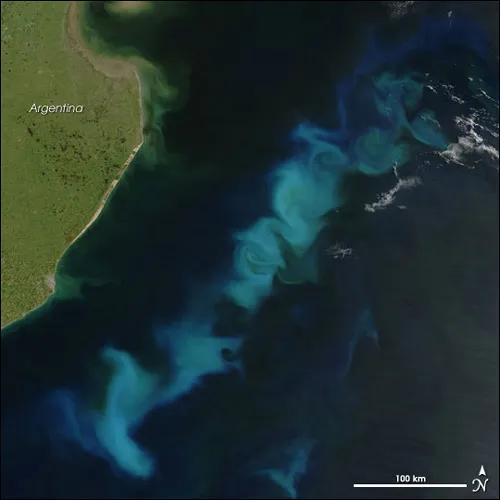
Swirling ocean currents carry the nutrients that fuel mysterious blooms of microscopic plants that have been found in otherwise barren regions in the middle of Earth's oceans, scientists found.
For years, scientists were puzzled by the vast blooms of phytoplankton that erupted in the middle of the Sargasso Sea, for instance, a mid-ocean region that is warmer, saltier, bluer and clearer than most other parts of the North Atlantic. Because of these conditions, it was thought that the region was the desert of the ocean, with few signs of life.
But observations showed that oxygen and other elements were being consumed at a higher rate than theories and models could account for, leading scientist to think there must be some nutrient source fueling the blooms.
“Past research has shown that the open ocean is far more productive than we could explain based on what we knew about nutrients in the surface water,” said oceanographer Dennis McGillicuddy of the Woods Hole Oceanographic Institution in Massachusetts. “Scientists have been trying to figure out where the nutrients come from to make these oases in the oceanic desert.”
In a new study detailed in the May 18 issue of the journal Science, researchers have shown that eddies, episodic swirling current systems, pump nutrients up from the ocean’s depths to feed the phytoplankton.
“Eddies are the internal weather of the sea, the oceanic equivalent of storms in the atmosphere” said McGillicuddy, also the study’s leader.
The eddies pull up nutrient-rich water from deep in the ocean, fertilizing the “euphotic” zone, or the layer of the ocean where sunlight penetrates. With these two essential ingredients of photosynthesis, phytoplankton numbers rise; in turn, they attract zooplankton and other animals higher up the food chain.
Get the world’s most fascinating discoveries delivered straight to your inbox.
- Top Ten Unexplained Phenomena
- Images: Under the Sea
- All About Oceans
