Space-Time Distortions Uncover Hidden Galaxies

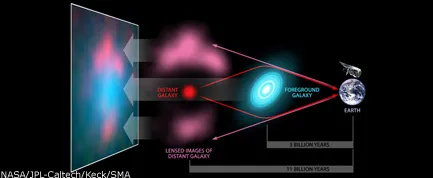
Previously hidden behind veils of dust, ancient galaxies have been detected using an effect caused by the space-time distortions in the vast distance between those galaxies and Earth.
The discovery of the distant galaxies could shed light on formation of the early universe and galaxies, researchers said. [New photo of the ancient galaxies]
Distant galaxies are normally difficult to see, but those whose dim light are shrouded in dust are especially difficult to detect, even using the largest available telescopes. However, astronomers are able to essentially boost the effectiveness of their telescopes by relying on lenses of a sort — massive galaxies or clusters of galaxies between the astronomers and the objects they want to look at.
The gravitational pull of massive intervening objects distorts space-time, an effect that can deflect light. This "gravitational lensing" can increase the visibility of the distant galaxies — or possibly lead researchers to seeing multiple images of them.
Typically, finding gravitational lenses is very time-consuming. Now, using data from the Herschel Space Telescope, a large, international research team has found that gravitationally lensed galaxies can be detected easily in submillimeter wavelengths of light if a sufficiently wide area of the sky is searched.
The objects seen in the submillimeter range are generally thought to be distant, dusty galaxies undergoing a vigorous burst of star formation. This intense activity generates the dust that obscures them. In a wedge of sky that researchers analyzed, they discovered what appears to be five new gravitationally lensed, dusty star-forming galaxies.
"I was predicting about four to six of these sources to be detected in our first data collected one year ago," said researcher Mattia Negrello, an astronomer and cosmologist at The Open University in Milton Keynes, England. "Those data corresponded to about 3 percent of the total area that will be mapped by Herschel within the H-ATLAS (Herschel Astrophysical Terahertz Large Area Survey). You can imagine how excited I was when we discovered exactly five."
Get the world’s most fascinating discoveries delivered straight to your inbox.
The method the researchers used was simpler than past techniques.
They observed the sky for submillimeter radiation, identified the brightest objects and removed a few "contaminants" such as nearby galaxies. Everything that was left turned out to be the star-forming galaxies. "This is arguably the easiest way to spot gravitational lensing events ever conceived," Negrello said.
The five galaxies the researchers found are just the tip of the iceberg, Negrello told SPACE.com. "We expect to discover more than 100 of them in the full H-ATLAS," he said. By capturing details amplified by gravitational lensing on large numbers of these galaxies, the scientists hope to better understand how they formed and evolved.
The scientists detailed their findings in the Nov. 5 issue of the journal Science.
- Gallery: Photos Catch Thousands of Galaxies Together at Once
- Video: Black Holes: Warping Time & Space
- Dark Energy Mystery Illuminated By Cosmic Lens
This article was provided by SPACE.com, a sister site of LiveScience.com.