















Man and Nature Combine to Create Ozone Holes

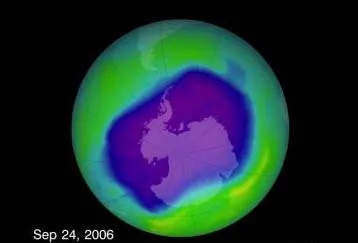
Scientists said today the Antarctic ozone hole, caused largely by human pollution, is not showing any signs of recovery so far this year. Meanwhile, a separate study shows that nature itself is destroying ozone high in the atmosphere over Earth’s North Pole.
Ozone is a colorless gas that in the stratosphere (6 to 30 miles above the planet’s surface) absorbs harmful ultraviolet radiation from the sun. Without the ozone, skin damage would suddenly be worse and the planet would be downright hostile to life as we know it.
Holes, which are really areas where ozone is very thin, occur over each pole during their respective hemisphere’s spring. Typically these holes form when sunlight breaks up man-made chemicals, like chloroflurocarbons (or CFCs), and resulting gases such as chlorine destroy the ozone.
But other naturally-occurring chemicals can also eat away at the ozone.
Strong winds
In March 2006, stronger-than usual winds circling high above the Arctic pulled ozone-destroying nitrogen oxides down in altitude some 30 miles, where they could attack ozone in the upper stratosphere, according to a study in the Sept. 27 issue of the journal Geophysical Research Letters.
The destructive nitrogen oxides are created above the stratosphere when sunlight breaks up nitrogen and oxygen molecules.
Get the world’s most fascinating discoveries delivered straight to your inbox.
This finding shows that the winds have a greater impact on ozone levels than scientists previously thought. The destruction caused by the winds around the North Pole is only rivaled by the nearly 60 percent reduction in ozone molecules that occurred there in the winter of 2003-2004, when a series of powerful solar storms bombarded the region, creating higher levels of nitrogen oxides.
"We knew strong winds would lead to more [nitrogen oxides] in the stratosphere if there were solar storms, but seeing that much come down into the stratosphere when the sun was essentially quiet was amazing," said lead author Cora Randall of the University of Colorado at Boulder.
This upper-level destruction occurs far above the lower stratosphere’s CFC-induced ozone hole, and so doesn’t cause an immediate health threat. But it could have unanticipated climate consequences because the upper-level ozone usually heats up the stratosphere as it absorbs ultraviolet radiation, according to Randall.
Human-induced climate change might also affect the strength of the polar winds, which could pull even more nitrogen oxides down into the stratosphere, she said.
"The atmosphere is part of a coupled system, and what affects one layer of the atmosphere can influence other layers in surprising ways," Randall said. "We will only be able to predict and understand the consequences of human activities if we study the entire system as a whole, not just in parts."
No Recovery over Antarctica
Studying the consequences of human activities on ozone is just what NASA scientists are doing at the bottom of the globe. Today, researchers released the latest image of the Antarctic ozone hole.
Scientists have been monitoring the ozone hole’s annual maximum for signs of improvement since the Montreal Protocol, which phased out CFC’s, was passed 19 years ago.
"The Antarctic ozone hole will reach sizes on the order of 8-10 million square miles nearly every year until about 2018 or so," said Paul Newman, a senior research scientist at NASA’s Goddard Space Flight Center. That area is larger that all of North America. Between 2020 and 2025, Newman expects to see detectable decreases in the hole’s size, but says it probably won’t reach normal levels until around 2070.
"So we will soon see what this year’s peak will reveal about the ozone hole and our ability to predict its development and recovery," Newman said. Meantime, in a statement, he and colleagues said: "Though it is still too early to tell, the 2006 Antarctic ozone hole has not shown any substantial signs of recovery."
- Ozone Hole Could Persist to 2065
- Sun's Temper Blamed for Arctic Ozone Loss
- Surprise: High Ozone Levels in Mountains of Tibet
