















Chemical Engineer Purifies Water with Prickly Pear
This ScienceLives article was provided to LiveScience in partnership with the National Science Foundation.
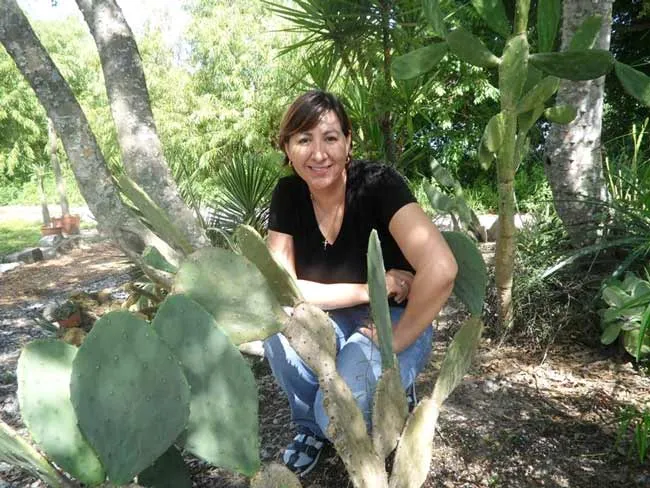
Norma Alcantar is an associate professor in the department of chemical and biomedical engineering at the University of South Florida. She is investigating properties of green materials and their reactions with contaminates in drinking water. Her research has found that the gummy substance, or mucilage, found in cactus can remove heavy metals, particulates and even bacteria from water. Alcantar’s concept is to adapt this material into portable devices for rural and underdeveloped communities that have been exposed to polluted drinking water, and where access to conventional filtration technology is limited. Her team has focused on the prickly pear cactus, or nopal, which is widely found in dry regions of Mexico, the western U.S., and the Mediterranean. Because the cactus can be grown locally, sustainably and at low cost, it could be an ideal agent for water treatment in those areas. This summer Alcantar will be traveling to Haiti to investigate the feasibility of purifying water with cactus in parts of the country where the January 2010 earthquake disrupted the supply of clean water. A piece about Alcantar’s work is available from her homepage here, and below, she answers the ScienceLives 10 Questions.
Name: Norma A. Alcantar Age: 39 Institution: University of South Florida Field of Study: Properties of thin films and biosystems, conducting organic thin films, biomaterials engineering and surface interactions
What inspired you to choose this field of study? My inspiration to study a chemistry-related subject came from my chemistry instructor in middle school. She showed me the beauty of chemistry, biology and materials. I decided to pursue chemical engineering because it is a discipline that provides you with the tools to develop solutions to problems in physico-chemistry and materials sciences. It also provides the background to encounter bioengineering problems and find a creative solution.
What is the best piece of advice you ever received? “Hagas lo que hagas, hazlo bien.” It translates as: no matter what the task is, do your best.
What was your first scientific experiment as a child? My very first memory about applying science is when I had to grow a green plant from beans. I remember I put the beans in an alcohol-wet cotton wrap, and I then watched the seed breaking and the sprouts coming out from the bean. Within a week I had a nice green plant with leaves that was ready to be transplanted into soil. It was amazing. I remember doing it several times just to see if I could catch the exact moment when the green sprout broke free from the seed. I watched for hours. I finally saw it and it was amazing to see Nature at work.
What is your favorite thing about being a scientist or researcher? The fact that I can appreciate Nature’s work and that I can attempt to learn its secrets and mimic them.
Get the world’s most fascinating discoveries delivered straight to your inbox.
What is the most important characteristic a scientist must demonstrate in order to be an effective scientist? An effective scientist should be skeptical (you should always question your findings and discoveries with an objective mind) and creative (you should always think about better ways to do something and figure out the optimal path for achievement).
What are the societal benefits of your research? My research projects are very practical and applicable even though we focus on investigating basic science. My hopes are that someday our research would be able to alleviate water pollution and provide safe drinking water to communities in need.
Who has had the most influence on your thinking as a researcher? My grandmother and mother were the most influential mentors for me. They taught me to be curious and encouraged it. They did not provide me with the answer when I asked questions; instead they gave me clues and pieces so that I could figure out the answer by myself. I think that is how a researcher should think.
What about your field or being a scientist do you think would surprise people the most? Most people expect that the explanations for certain scientific phenomena are very complex. I think most scientific questions have a simple explanation. You just have to discover it. The fact that people think science and engineering are very difficult fields is a misconception that has kept the majority of women out of these courses of study in the past. I hope this can be changed for young female minds in the future.
If you could only rescue one thing from your burning office or lab, what would it be? I have been investigating the use of cactus for purifying water, so I guess it would have to be a cactus extract that we obtained in 2004 and that we are testing for its shelf life. It is still active and we want to determine how much longer it will last under standard storage conditions. Since this is a time-sensitive experiment, it would take at least another 6 years to repeat.
What music do you play most often in your lab or car? I play Yellow Submarine (The Beatles) in my car for my son all the time. In my lab, I play Dido’s first album (No Angel) a lot. I also play Nicholas Gunn’s The Sacred Fire, especially when I have to write proposals.
Editor's Note: This research was supported by the National Science Foundation (NSF), the federal agency charged with funding basic research and education across all fields of science and engineering. Any opinions, findings, and conclusions or recommendations expressed in this material are those of the author and do not necessarily reflect the views of the National Science Foundation. See the ScienceLives archive.