













Mini Triceratops First Horned Dinosaur from S Korea
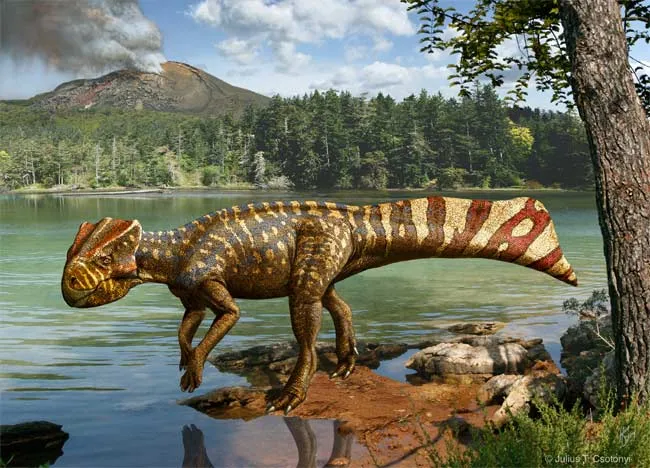
A Labrador-size dinosaur related to Triceratops with scaled-down headgear and a fanned structure on its tail plodded what is now South Korea about 103 million years ago, researchers report today (Dec. 7).
The specimen is the first horned dinosaur, also called a ceratopsian, to be discovered on the Korean peninsula. Described in the Nov. 18 issue of the journal Naturwissenschaften: The Science of Nature, the specimen includes the animal's backbone, hipbone, partial hind limbs and a nearly complete tail.
The newly discovered dinosaur, dubbed Koreaceratops hwaseongensis, lived during the late Early Cretaceous period. (famed Triceratops lived about 65 million years ago.) As such, the specimen "fills in a missing 20 million-year gap in the fossil record between the origin of these dinosaurs in Asia and their first appearance in North America," said study co-author Michael J. Ryan, curator and head of vertebrate paleontology at The Cleveland Museum of Natural History.
Results from the analysis of the specimen were published in the Nov. 18 online edition of the journal Naturwissenschaften: The Science of Nature.
"This is a rare find," Ryan said. "Fossils of dinosaurs have not typically been found in this region, whereas evidence of dinosaur eggs and footprints occur more commonly."
At approximately 5 to 6 feet long and weighing just 60 to 100 pounds, the animal was relatively small compared with the geologically younger, giant relatives like Triceratops found in North America. Its parrot-like beak at the front of its jaws suggests Koreaceratops was an herbivore. In fact, if you scaled down Triceratops' head frill and removed the horns, you'd have a good idea of what Koreaceratops looked like, Ryan said. [Image of Koreaceratops]
By examining its hind feet, Ryan and colleagues think the animal was bipedal and was a fairly fast mover.
Get the world’s most fascinating discoveries delivered straight to your inbox.
"It's the tail that's unique," Ryan said in an online video interview. For one, the tail was short for a dinosaur, about the length of its body. A series of long spines called neural arches project up from the tail and would have supported a large frill-like structure.
There are a number of ideas for why the dinosaur sported such a tail. "One is purely for show," Ryan said. "So if you support a large fan coming off the top of your tail you can have it colored brightly and if you turn sideways you can use it as a signaling device, almost waving it like a flag so you can signal the rest of your species or perhaps try to attract a mate."
The structure may have also helped with heat exchange, he added. The tail also could have helped the dinosaur swim, as the researchers think it spent part of its time hunting for aquatic food.
- 25 Amazing Ancient Beasts
- Newfound Horned Dinosaur Probably Island-Hopped to Europe
- Images: Dinosaur Drawings
You can follow LiveScience Managing Editor Jeanna Bryner on Twitter @jeannabryner.
Jeanna Bryner is managing editor of Scientific American. Previously she was editor in chief of Live Science and, prior to that, an editor at Scholastic's Science World magazine. Bryner has an English degree from Salisbury University, a master's degree in biogeochemistry and environmental sciences from the University of Maryland and a graduate science journalism degree from New York University. She has worked as a biologist in Florida, where she monitored wetlands and did field surveys for endangered species, including the gorgeous Florida Scrub Jay. She also received an ocean sciences journalism fellowship from the Woods Hole Oceanographic Institution. She is a firm believer that science is for everyone and that just about everything can be viewed through the lens of science.