













Enemy Anemones Wage All-Out War
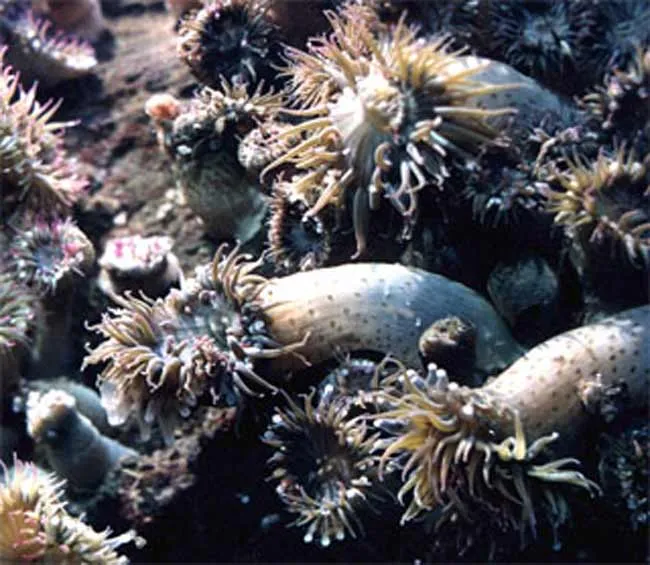
When the tide is out, sea anemones sit quiet and still. It's a totally different scene once the tide rolls back in, as neighboring colonies of polyps wage all-out war.
Each colony is an "army," with the troops divided up into scout, warrior, and reproductive rankings, new research shows.
Large colonies of the sea anemone Anthopleura elegantissima claim turf on tidal boulders, which they vehemently defend.
As the tide starts to cover the colonies, "scouts" move to the border and look for empty space to claim. The "warrior" anemones – which are larger and well-armed with stinging cells – provide backup by inflating their arms and slapping at enemies, sometimes from four rows back off the front lines.
Meanwhile, in the center of the colony, poorly armed anemones concentrate on reproduction, making sure there are enough "troops" to maintain the colony.
And they coordinate all these complex behaviors without a single brain among them.
Warring colonies form boundary zones – which can stay in place for years – between the two armies. Anemones that contact soldiers from another colony will fight, whacking each other with special tentacles that stick stinging cells on their enemies.
Get the world’s most fascinating discoveries delivered straight to your inbox.
The research was conducted by David Ayre of the University of Wollongong, Australia and Rick Grosberg from University California, Davis. They had previously studied one-on-one fights between sea anemones, but this study was the first to observe two entire colonies duking it out.
Rankings in the colony appear to depend on a combination of signals from enemy stings and the colony's genetics, say the researchers. Different colonies react differently to similar signals. This causes colonies to organize their troops in different ways.
Sea anemones – named after a terrestrial flower – are water-dwelling, filter feeding animals. As members of the phylum Cnidaria, they are closely related to coral and jellyfish. Sea anemones have a foot which most species use to anchor themselves in sand or attach to rocks. Other species use their foot to attach to kelp, but some are free-swimming.
The new findings, announced today, were detailed in the June issue of the journal Animal Behaviour.