













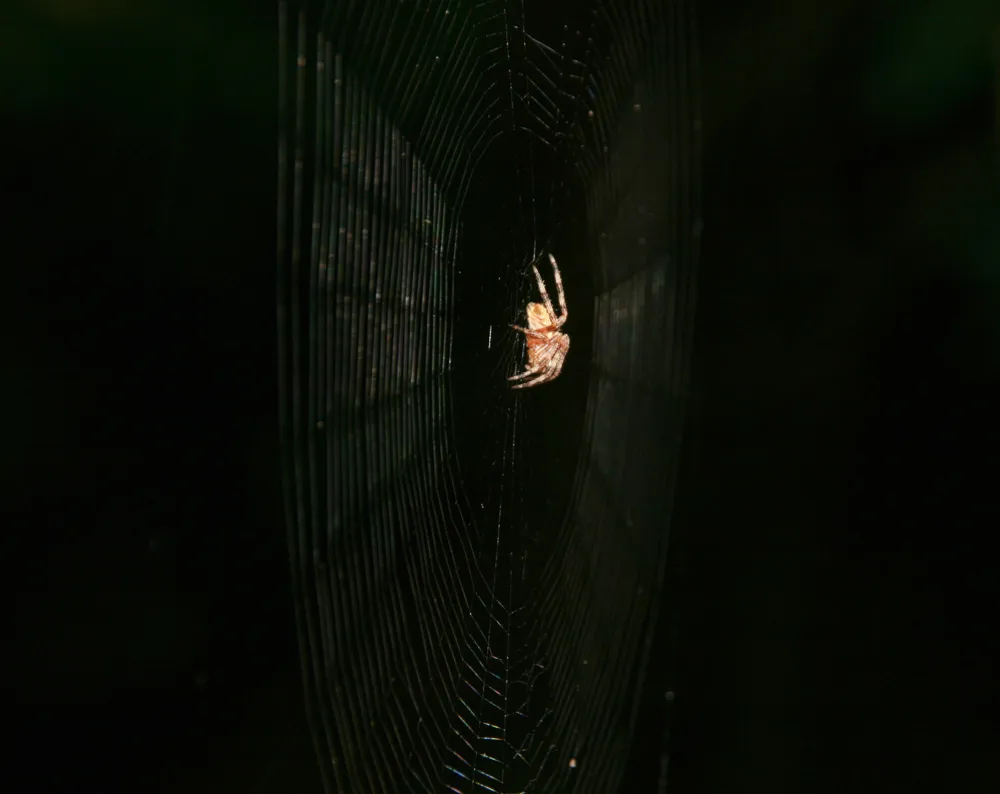
Spiders may trap unsuspecting prey by sucking them in using electrostatic attraction, new research suggests.
The new study, published today (July 4) in the journal Scientific Reports, found that the spiderweb of the common cross spider (or garden spider) is attracted to electrically charged objects, with the sticky threads of spider silk arcing toward each other in response to a charged object.
Stroke of inspiration
Some flying insects, as they flap their wings, for instance, generate an electric charge. As such the new results suggest that charged bugs such as honeybees could be sucked into, and then trapped by, a spider's sticky web as they fly by. [Ewww! Photos of Bat-Eating Spiders]
"Charged insects can produce a deformation of a spiderweb," said study co-author Victor Ortega-Jimenez, a biologist at the University of California, Berkeley. "Any insect that is flying very close to the spiderweb can be trapped by the electrostatic effect."
Ortega-Jimenez noticed this phenomenon while playing with a simple toy with his daughter: an electrostatically charged "magic wand" that can cause objects such as paper to levitate. While doing so, they decided to charge up a few insects and even brought it near a spiderweb that was nearby, which deformed in response to the magic wand
He also knew that honeybees generate an electric charge of up to 200 volts as they flap their wings, which may help them pick up pollen from negatively charged flowers. Several studies have revealed that spiderwebs can dramatically deform in response to prey. So he wondered whether spiderwebs could use electrostatic attraction to lure prey.
Get the world’s most fascinating discoveries delivered straight to your inbox.
Charging webs
To find out, Ortega-Jimenez and his colleague Robert Dudley gathered spiderwebs of the cross spider (Araneus diadematus) from around the UC Berkeley campus. Back at the lab, they studied how the spiderwebs responded to electrically charged objects.
They found that the web and positively charged objects were attracted to one another. What's more, the silk threads of the spiderweb curved toward each other underneath a charged honeybee that was falling toward it, making it likelier that the hapless insect would get entangled in the deadly web. The deformation was nearly half the length of the insects, a fairly big change. [See Video of Charged Spiderwebs]
"This is quite intriguing," said Markus Buehler, a materials scientist who studies spider silk at the Massachusetts Institute of Technology, who was not involved in the study. "This attraction pulls the insect to the web and enhances the likelihood that it is being caught in the web."
But it's not clear how often this strange effect plays out in nature. Cross spiders mostly dine on flies, not bees, and so far, no one has tested whether flies have an electric charge. The bigger question, Buehler said, is how many insects are electrically charged.
Follow Tia Ghose on Twitterand Google+. Follow LiveScience @livescience, Facebook & Google+. Original article on LiveScience.com.

Tia is the editor-in-chief (premium) and was formerly managing editor and senior writer for Live Science. Her work has appeared in Scientific American, Wired.com, Science News and other outlets. She holds a master's degree in bioengineering from the University of Washington, a graduate certificate in science writing from UC Santa Cruz and a bachelor's degree in mechanical engineering from the University of Texas at Austin. Tia was part of a team at the Milwaukee Journal Sentinel that published the Empty Cradles series on preterm births, which won multiple awards, including the 2012 Casey Medal for Meritorious Journalism.