













Former Global Warming Skeptic Makes a 'Total Turnaround'

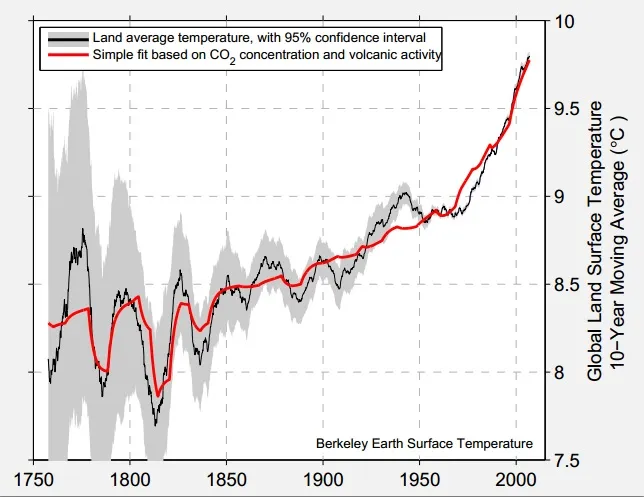
A prominent scientist who was skeptical of the evidence that climate change was real, let alone that it was caused by humans, now says he has made a "total turnaround." Richard Muller, a professor of physics at the University of California, Berkeley, says he has become convinced that "the prior estimates of the rate of warming were correct," and that humans are "almost entirely the cause" of that warming.
Muller co-founded the Berkeley Earth Surface Temperature (BEST) team two years ago in order to independently assess what he viewed as questionable evidence of global warming. In a series of papers published last year, BEST presented their statistical analysis of 1.6 billion temperature reports spanning the last 200 years, controlling for possible biases in the data that are often cited by skeptics as reasons to doubt the reality of global warming.
Their analysis indicated that global warming is real — that the average global land temperature has risen by 2.5 degrees Fahrenheit (1.4 degrees Celsius) since 1750, including 1.5 degrees F (0.9 degrees Celsius) in the past 50 years. The numbers closely agree with the findings of past studies by the National Oceanic and Atmospheric Administration (NOAA), NASA and others; but finally, they were rigorous enough to satisfy Muller.
Now, in a brand new study that probed the causes of that warming, the BEST team says it has cleared from blame the natural variations in Earth's climate that so often get implicated by skeptics. Muller and his colleagues implicate carbon dioxide emissions by humans as essentially the sole cause of global warming.
"The carbon dioxide curve gives a better match than anything else we've tried," he wrote Saturday (July 28) in a New York Times editorial. "Its magnitude is consistent with the calculated greenhouse effect — extra warming from trapped heat radiation. These facts don't prove causality and they shouldn't end skepticism, but they raise the bar: To be considered seriously, an alternative explanation must match the data at least as well as carbon dioxide does."
That's a high bar indeed. In graphs released with the new study, a red line representing the atmoaspheric concentration of CO2 crawls across the decades almost exactly tracing the black line representing the observed warming of the Earth. [What Are Climate Change Skeptics Still Skeptical About?]
By comparison, the study found that natural variability, including variations in the solar cycle, El Niño events and the Atlantic multidecadal oscillation (shifts in sea-surface temperatures that run in cycles), could have accounted for no more than 0.17 degrees Celsius of temperature variation — either warming or cooling — during the past 150 years. These natural forces are much subtler than the warming seen during the same time period.
Get the world’s most fascinating discoveries delivered straight to your inbox.
In fact, the new results indicate that humans have been warming the Earth for longer than climate scientists previously thought certain. "In its 2007 report, the [United Nations Intergovernmental Panel on Climate Change] concluded only that most of the warming of the prior 50 years could be attributed to humans," Muller wrote. "It was possible, according to the I.P.C.C. consensus statement, that the warming before 1956 could be because of changes in solar activity, and that even a substantial part of the more recent warming could be natural."
Not so, according to the new findings; variations in solar activity have a negligible effect on Earth's temperature. The handiwork is almost all our own.
"I embarked on this analysis to answer questions that, to my mind, had not been answered," Muller wrote. "I hope that the Berkeley Earth analysis will help settle the scientific debate regarding global warming and its human causes. Then comes the difficult part: agreeing across the political and diplomatic spectrum about what can and should be done."
Follow Natalie Wolchover on Twitter @nattyover or Life's Little Mysteries @llmysteries. We're also on Facebook & Google+.

Natalie Wolchover was a staff writer for Live Science from 2010 to 2012 and is currently a senior physics writer and editor for Quanta Magazine. She holds a bachelor's degree in physics from Tufts University and has studied physics at the University of California, Berkeley. Along with the staff of Quanta, Wolchover won the 2022 Pulitzer Prize for explanatory writing for her work on the building of the James Webb Space Telescope. Her work has also appeared in the The Best American Science and Nature Writing and The Best Writing on Mathematics, Nature, The New Yorker and Popular Science. She was the 2016 winner of the Evert Clark/Seth Payne Award, an annual prize for young science journalists, as well as the winner of the 2017 Science Communication Award for the American Institute of Physics.