













The Science of Knots Unraveled
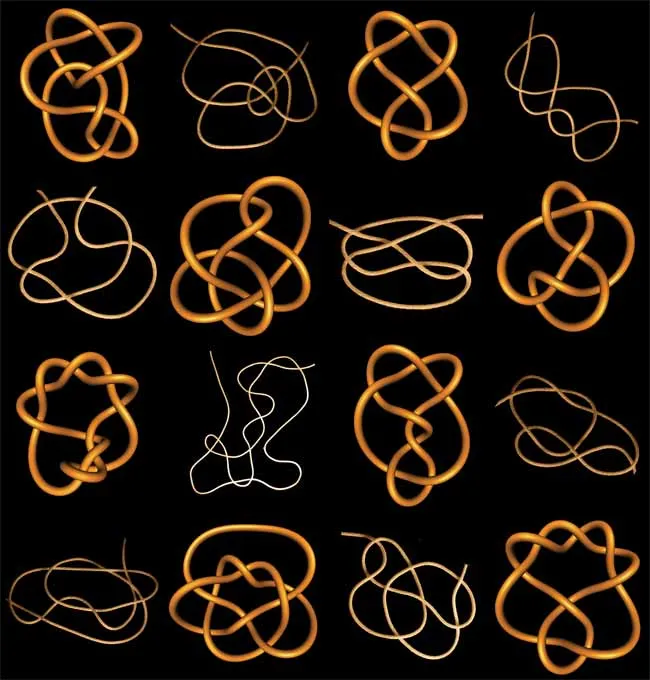
Tangled telephone cords and electronic cables that come to resemble bird nests can frazzle even the most stoic person. Now researchers have unraveled the mystery behind how such knots form.
Two physicists used string-tumbling experiments and mathematical models to create a step-by-step recipe for knot formation and determined which factors cause the knottiest knots. Their research, published online this week by the Proceedings of the National Academy of Sciences, sheds light on an everyday phenomenon about which little was known beyond the madness it incites.
"It's a common annoyance in everyday life, that anything that's like a string inevitably seems to get itself into a knot,” said the study's senior author Douglas Smith of the University of California, San Diego.
He added, “Very little experimental work had been done to apply knot theory to the analysis and classification of real, physical knots."
All tied up
Smith and UCSD colleague Dorian Raymer ran a series of homespun experiments in which they dropped a string into a box and tumbled it for 10 seconds (one revolution per second). They repeated the string-dropping more than 3,000 times varying the length and stiffness of the string, box size and tumbling speed.
Digital photos and video of the tumbling strings revealed: Strings shorter than 1.5 feet (.46 meters) didn't form knots; the likelihood of knotting sharply increased as string length went from 1.5 feet to 5 feet (.46 meters to 1.5 meters); and beyond this length, knotting probability leveled off.
Get the world’s most fascinating discoveries delivered straight to your inbox.
Observations could only go so far. “It is virtually impossible to distinguish different knots just by looking at them,” Raymer said.
Raymer developed a computer program to try and mimic their observations. From the model, they created a simplified "lifecycle" of a knot from tidy beginning to titanic tangle. Once dropped, the string formed concentric coils. Next, the string's free end weaved through the coils, with a 50 percent likelihood of crossing under or over the coil and following a path to the left or right.
Knot busters
The best knotting came from very flexible, long string contained in a large box. "A highly flexible string placed in a very large container will have a higher probability of becoming knotted than a stiff one that's confined in a smaller container," Smith told LiveScience.
The researchers suggest that cramped quarters limit the tumbling motion that facilitates the string weaving through the coils. That would explain why knots were less likely to form in smaller compared with larger boxes.
But in real life, most people don't tumble cords and wires on a daily basis. Smith explained that while this tumbling is not a requirement for knots to form, some motion is necessary.
"Surprisingly little disturbance or motion is even needed," Smith said. "It's quite easy for something to get knotted." Even the act of picking up the phone and placing it back down could be enough jostling to trigger knot formation.
While there is no magical knot buster, Smith advised what all sailors, cowboys, electricians, sewers and knitters know: to avoid tangles, keep a cord or string tied in a coil so it can't move.
- Top 10 Unexplained Phenomena
- The Biggest Popular Myths
- Life's Little Mysteries
Jeanna Bryner is managing editor of Scientific American. Previously she was editor in chief of Live Science and, prior to that, an editor at Scholastic's Science World magazine. Bryner has an English degree from Salisbury University, a master's degree in biogeochemistry and environmental sciences from the University of Maryland and a graduate science journalism degree from New York University. She has worked as a biologist in Florida, where she monitored wetlands and did field surveys for endangered species, including the gorgeous Florida Scrub Jay. She also received an ocean sciences journalism fellowship from the Woods Hole Oceanographic Institution. She is a firm believer that science is for everyone and that just about everything can be viewed through the lens of science.