Dolphin-Inspired Tech Sees Through Bubbles

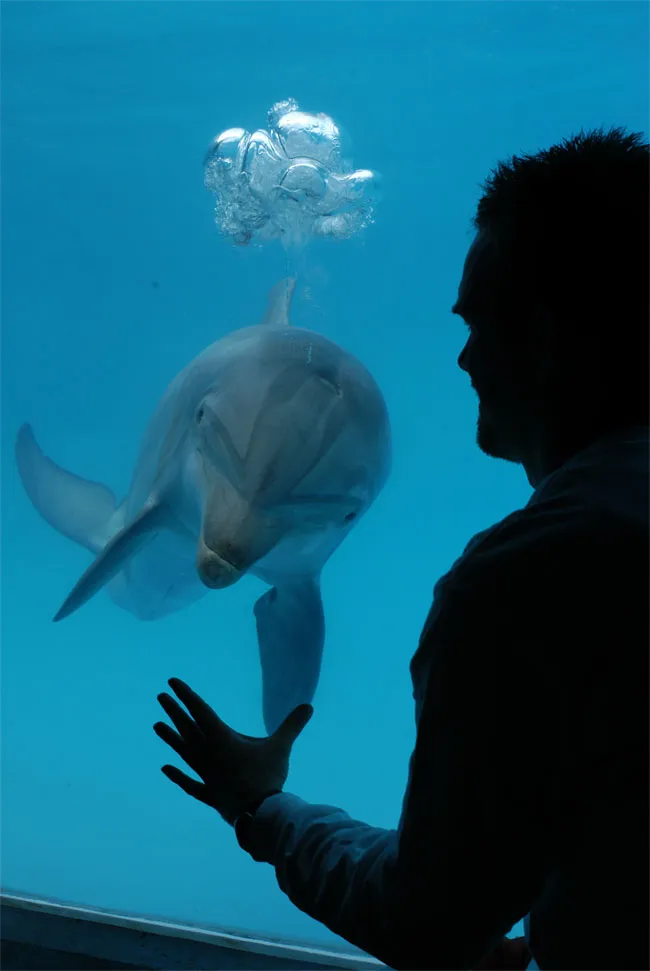
By thinking about how dolphins might solve problems using echolocation — the method the marine mammals use to locate objects within water — researchers have come up with a way to detect objects through bubble clouds that would effectively blind man-made sonar systems.
The new technique could prove helpful in shallow waters, where bubbly water is more common and where sonar is increasingly finding use.
Sonar operates much the same way as the echolocation used by dolphins and bats. By analyzing the differences between emitted sound pulses and their echoes, sonar can detect and identify targets.
Unfortunately, standard sonar does not perform well when bubble clouds are present, which scatter sound and clutter sonar images. Bubble clouds are common from breaking waves in shallow waters.
"Cold War sonar was developed mainly for use in deep water where bubbles are not much of a problem, but many of today's applications involve shallow waters," said researcher Timothy Leighton, a physicist at the University of Southampton. "Better detection and classification of targets in bubbly waters are key goals of shallow-water sonar."
"Look at the coastal waters around the Persian Gulf -- they are full of crud-like bubbles from breaking waves on the shoreline and mud from the rivers Euphrates and Tigris," Leighton told TechNewsDaily. "Mines here are hidden. The U.S. Navy used dolphins and divers here, as sonar did not work to find mines in this region."
Leighton turned to dolphins for inspiration after learning that the animals weave circular “bubble nets” around schools of fish. The nets force the fish to cluster together, making them easier for the dolphins to pick off.
Get the world’s most fascinating discoveries delivered straight to your inbox.
“It occurred to me that either dolphins were blinding their sonar when making such nets, or else they have a better sonar system,” Leighton said.
Scientists don’t know what type of sonar dolphins use while hunting with bubble nets, so Leighton couldn’t copy from dolphins directly. "I sat down and worked out what pulse I would use if I were a dolphin," he said.
The result was a new sonar concept named twin inverted pulse sonar (TWIPS). This novel technique exploits the way that bubbles pulsate in sound fields, which influences the characteristics of sonar echoes.
This method uses a series of twinned pairs of sound pulses, with the first pulse of each pair emitted a fraction of a second before its twin. The waveform of the first pulse is an inverted replica of that of its twin.
Unlike the case with inert solids, sound pulses cause bubble walls to move significantly. The bubble expansion that a sound pulse causes cannot exactly match the bubble compression experienced by an inverted replica of that pulse -- although the bubble can expand as far as it likes, it cannot compress to the point that it disappears altogether. In this way, researchers can tell which echoes reflected off solid targets versus those from bubbles.
In experiments in a water tank, the researchers found their method outperformed standard sonar at detecting a small steel disc under bubbly conditions resembling those found under oceanic breaking waves. They next conducted trials at sea aboard a coastal research vessel, comparing their technique with standard sonar that scans the seabed in Southampton Water.
"TWIPS outperformed standard sonar in the wake of large vessels such as passenger ferries," said researcher Justin Dix at the University of Southampton.
In addition to scanning the water for targets, another use for TWIPS is its ability to detect bubbles in materials -- they weaken sediment if one wants to build bridges, for instance, and they can lead to blowouts when drilling for oil, as seen in the Deepwater Horizon disaster. Industrially, they can also look for bubbles in ceramics, glasses, plastics and other materials that can cost millions of dollars in useless — and thus wasted — products.
This method of using twinned pulses could also help remove clutter from radar as well. As such, one could use it to detect hidden electronic bugs and improvised explosive devices, or IEDs.
"I really hope that radar systems using the technique can be built that would detect IEDs in Afghanistan, as that would be very important," Leighton said.
The research is detailed in the Dec. 8 issue of the Proceedings of the Royal Society A.