














Will Your Tongue Really Stick to a Frozen Flagpole?
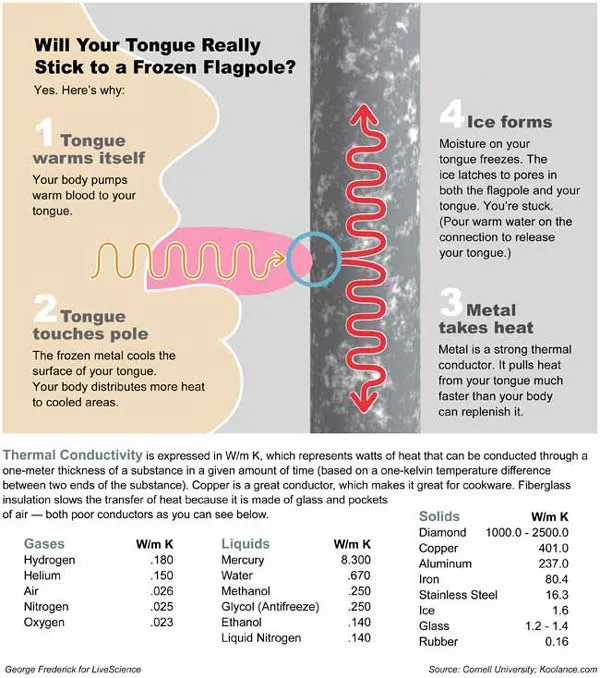
The next time someone triple-dog dares you to stick your tongue to a frozen metal pole — don't. Your tongue will be joined to the pole, and you'll have plenty of time to ponder the thermal conductivity of metal while you await the rescue squad.
Your tongue is covered with moisture, which beings to freeze if its temperature drops below 32 degrees Fahrenheit. Your body counteracts the freezing by pumping warm blood to your tongue.
Heat from your blood warms the moisture through a process called conduction . Heat energy from the blood excites atoms in your tongue. The atoms absorb energy and vibrate. The more they vibrate, the more their temperatures increase. This incites vibrations in neighboring atoms, which take the energy and pass it up the line like a hot potato and eventually warms the surface moisture.
So why is the Fire Department on its way?
"It's because of the high thermal conductivity of the pole," explains Frank J. DiSalvo, director of the Cornell Center for a Sustainable Future and co-director of the Cornell Fuel Cell Institute. "The metal is a much better conductor than your tongue (up to 400 times more powerful). The metal takes heat faster than your body can replenish it."
The atoms in solid metals are packed tightly and transfer thermal energy more readily. They also have free electrons that boost conductivity. Free electrons are free to move from atom to atom. The electrons absorb heat energy and move through the flagpole, stirring up other atoms.
As your tongue touches the flagpole, the moisture on your tongue is robbed of heat. The temperature of the moisture drops. Water freezes inside tiny pores and surface irregularities on your tongue and the pole. You're stuck.
Get the world’s most fascinating discoveries delivered straight to your inbox.
So now your thinking, "Maybe if I just pull hard it will come off." Yes, it will — a piece of your tongue, that is.
Kent Sperry is a 911 dispatcher at a place where people know about cold and snow — Boulder, Colorado. He offers a less painful alternative, assuming you happen to have the necessary remedy at hand: "Pour warm water on the area where the tongue meets the pole, and the tongue should come free."
Follow Life's Little Mysteries on Twitter @llmysteries. We're also on Facebook & Google+.