















Paranoia Pervasive, Study Finds
Paranoia is far more pervasive in the general population than anyone was willing to admit, a new study finds. Mumbling and furtive glances seem to be everywhere.
In our daily interactions with others, we pick up on facial and other cues that help us judge whether or not to trust another person. These judgments, however, are error-prone and can lead to exaggerated or unfounded fears about threats from others. These paranoid thoughts can range from thinking strangers are looking at you critically, or that others are spreading nasty rumors about you, to the feeling that others are deliberately trying to harm you in some way. "Paranoid thoughts are often triggered by ambiguous events, such as people looking in one's direction or hearing laughter in a room," said lead researcher Daniel Freeman, Wellcome Trust researcher at the Institute of Psychiatry at King's College London.
This phenomenon can be tricky to study, Freeman said, because it's difficult to recreate such social interactions in the lab. "Virtual reality allows us to do just that, to look at how different people interpret exactly the same social situation," he said.
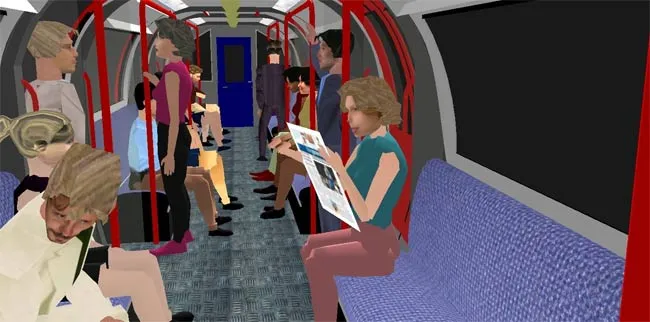
Freeman and his colleagues equipped 200 volunteers with virtual reality headsets. The volunteers stepped into a virtual London underground subway, where they walked around during the four-minute trip between stations. Scattered throughout the train car were avatars that breathed, looked around and sometimes met a participant's gaze. One avatar read a newspaper and another occasionally smiled if looked at.
The participants reacted differently to the same avatars. While the volunteers most commonly perceived the virtual train riders as friendly or neutral, nearly 40 percent of participants reported at least one paranoid thought.
"It is an excellent example of the importance of interpretation," Freeman told LiveScience. "Two people can see the same things but draw completely opposite conclusions."
For instance, one participant said, "There was a guy spooking me out – tried to get away from him. Didn’t like his face. I’m sure he looked at me more than a couple of times though might be imagining it."
Get the world’s most fascinating discoveries delivered straight to your inbox.
One woman reported, "Felt trapped between two men in the doorway. As a woman I’m a lot more suspicious of men. Didn’t like the close proximity of the men. The guy opposite may have had sexual intent, manipulation or whatever."
Another participant reported perhaps a more threatening fear: "There’s something dodgy about one guy. Like he was about to do something — assault someone, plant a bomb, say something not nice to me, be aggressive."
The researchers also evaluated the volunteers before entering the virtual train car. Those who were anxious or worried or worst-case scenarios painters or had low self-esteem were most likely to report paranoid thoughts.
The research, funded by the Wellcome Trust, will be detailed in the April 1 issue of the British Journal of Psychiatry.
- Top 10 Mysteries of the Mind
- The Biggest Popular Myths
- 10 Things You Didn't Know About You
Jeanna Bryner is managing editor of Scientific American. Previously she was editor in chief of Live Science and, prior to that, an editor at Scholastic's Science World magazine. Bryner has an English degree from Salisbury University, a master's degree in biogeochemistry and environmental sciences from the University of Maryland and a graduate science journalism degree from New York University. She has worked as a biologist in Florida, where she monitored wetlands and did field surveys for endangered species, including the gorgeous Florida Scrub Jay. She also received an ocean sciences journalism fellowship from the Woods Hole Oceanographic Institution. She is a firm believer that science is for everyone and that just about everything can be viewed through the lens of science.