















Earth's Air Divided by Chemical Equator

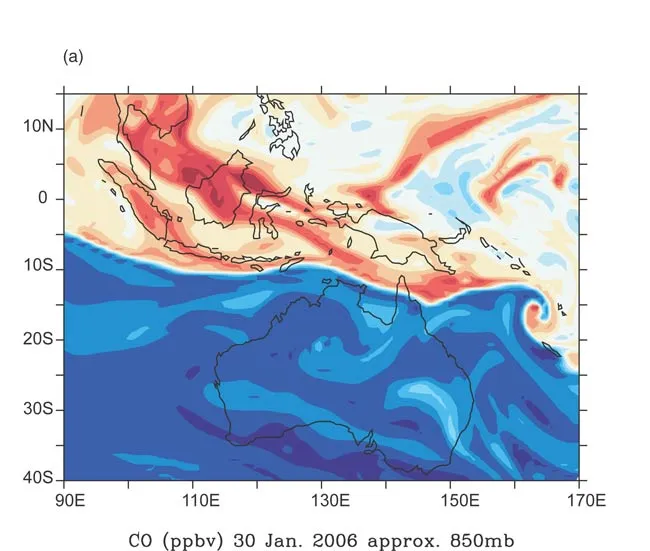
Scientists have found a temporary "chemical equator" that separates the heavily polluted air of the Northern Hemisphere from the cleaner air of the Southern Hemisphere over the Western Pacific — only it isn't where they expected to find it.
The Northern Hemisphere tends to have more polluted air than the Southern Hemisphere because it has more cities, more population in those cities on average and more industry. And each hemisphere's air masses tend to stay segregated from one another. That allows scientists to "see" chemical boundaries between the air masses of hemispheres by monitoring big changes in levels of air pollution.
These boundaries, or chemical equators, can typically be found at a "wall" created by global air circulation patterns that separates Northern and Southern hemispheric air. Called the Intertropical Convergence Zone (ITCZ), it is a belt of low pressure that circles the Earth roughly at the equator.
This is a good place to look for chemical equators, or partial ones, between the two hemispheres, but it is not where Geraint Vaughan of the University of Manchester in England and his colleagues found one in the Western Pacific.
Confining air
To see why Vaughan and his fellow researchers wanted to look at the ITCZ, it helps to know that it is effectively where parts of each hemisphere's circulation pattern meet. These parts are called Hadley cells and they feature the rise of warm, moist air on either side of the equator, which then travels poleward, descends at around 30 degrees North and South latitude respectively and finally travels back toward Earth's geographic equator as the trade winds.
Though the location of the ITCZ can vary over time, this circulation keeps the air — and any pollution it contains — confined to its own hemisphere.
Get the world’s most fascinating discoveries delivered straight to your inbox.
But this schematic is an "over-simplification," said Geraint Vaughan of the University of Manchester in England, a member of the team that discovered the chemical equator, which will be detailed in an upcoming issued of the Journal of Geophysical Research – Atmospheres. The team's work was funded by the United Kingdom's Natural Environment Research Council. Just looking at the ITCZ can oversimplify things because air masses aren't always that neatly separated, especially in the Pacific Ocean where Vaughan and his colleagues did their work.
Monsoon effects
Over parts of the Pacific Ocean, the clear band of the ITCZ visible over other oceans gives way to a "big blob of convection," Vaughan told LiveScience. Around Northern Australia, this convection is dominated by the Australian-Indonesian monsoon (a reversal in the usual surface wind direction) in the Southern Hemisphere summer.
When Vaughan and his team were in Darwin, on the northern coast of Australia, in January and February of 2006, the monsoon flow meant that the ITCZ was situated to the south of Darwin over central Australia. The team expected to see dirty, Northern Hemisphere air there, marking a local chemical equator, but the air was surprisingly clean.
So, they used a specially-equipped plane to fly north of Darwin to "find some dirty air," as Vaughan put it, when they happened upon a steep gradient in carbon monoxide levels — an indicator of a chemical equator of sorts. Carbon monoxide is a toxic gas found in polluted air and therefore more strongly associated with the Northern Hemisphere.
Strange appearance
While the ITCZ is cloudy because of the convection there, the chemical equator over the western Pacific was in cloudless skies, surprising Vaughan's team. The equator was also narrower than the ITCZ, with a width of about 31 miles (50 kilometers).
Vaughan and his colleagues think that this chemical equator formed because the monsoon flow brought clean air from over the southern Indian Ocean, while a stormy region over the western Pacific pumped in highly polluted air from over Indonesia.
This equator only persists for a short time during the monsoon season; Vaughan and his colleagues don't yet know whether other chemical equators outside the ITCZ are present in other areas of the world.
- The World's Weirdest Weather
- Quiz: Global Weather Extremes
- What is a Monsoon?

Andrea Thompson is an associate editor at Scientific American, where she covers sustainability, energy and the environment. Prior to that, she was a senior writer covering climate science at Climate Central and a reporter and editor at Live Science, where she primarily covered Earth science and the environment. She holds a graduate degree in science health and environmental reporting from New York University, as well as a bachelor of science and and masters of science in atmospheric chemistry from the Georgia Institute of Technology.