













Talk, Talk, Talk: One Thing We Do Better than Apes
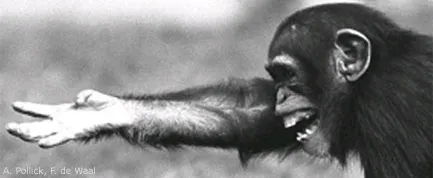
Anthropologists and others used to have a list of behaviors that separated us from the apes. Humans were the only ones to use tools, utilize culture, have complex feelings and communicate by language.
But over the years, each one of these so-called uniquely human abilities, except language, has fallen by the wayside.
For example, chimps expertly crack nuts using stones of just the right heft, fish for termites with finely fashioned stick rods and soak up rainwater with nicely crumpled leaf sponges.
And over the range of chimpanzees, differing groups take on signature behaviors that can only be considered cultural, even multicultural.
Chimpanzees also exhibit empathy, sympathy and a sense of morality; in some cases, they are better humans than we are.
But chimps can’t tell us about their culture or their feelings; they can’t talk about the past or what they might expect in the future; they can’t verbally explain to their offspring how to crack a nut or crumple a leaf because only humans can talk.
It is true, of course, that some chimps have been taught to communicate in a word-like fashion by making broad gestures with their hands or by using plastic tokens or a keyboard in place of words. They “get” that gestures and pictures represent something else.
Get the world’s most fascinating discoveries delivered straight to your inbox.
But they are hard-pressed to make a decent sentence, even with plastic shapes, and it takes years for them to master any of the ways humans have devised to teach them language.
No wonder.
Chimpanzees never evolved the physical apparatus that allows for speech production, and their brains were never selected to communicate with language.
At this point, we also have no idea if female chimps "outtalk" male chimps (via gestures or otherwise), as has been assumed of female and male humans for some time.
A recent article in the journal Science (July 6) dismissed the closely held belief that women talk more than men. For those of us who chose a male partner because he seemed like the quiet type, only to discover that behind closed doors he never shuts up, this study is very old news.
In any case, for humans, language was an evolutionary watershed.
Some time in our past, communicating with complex sounds that became language was an advantage. Perhaps we were selected to give complex directions about hidden food, or verbally teach things to kids, or plot revenge and bolster friendship with words.
Language is an evolutionary gift, and yet these days we often use this magnificent ability to remark, “Hey lady, you talk too much.”
Meredith F. Small is an anthropologist at Cornell University. She is also the author of "Our Babies, Ourselves; How Biology and Culture Shape the Way We Parent" (link) and "The Culture of Our Discontent; Beyond the Medical Model of Mental Illness" (link).
- Top 10 Missing Links
- Video: Monkey in the Mirror
- Top 10 Deadliest Animals