Get the world’s most fascinating discoveries delivered straight to your inbox.
You are now subscribed
Your newsletter sign-up was successful
Want to add more newsletters?
Join the club
Get full access to premium articles, exclusive features and a growing list of member rewards.
An account already exists for this email address, please log in.
Bandera Volcano Ice Cave: The weird lava tube in New Mexico whose temperature is always below freezing
Due to a weird quirk of geology, New Mexico's Bandera Volcano Ice Cave never warms above 31 degrees Fahrenheit, even when temperatures outside exceed 100 F in summer.
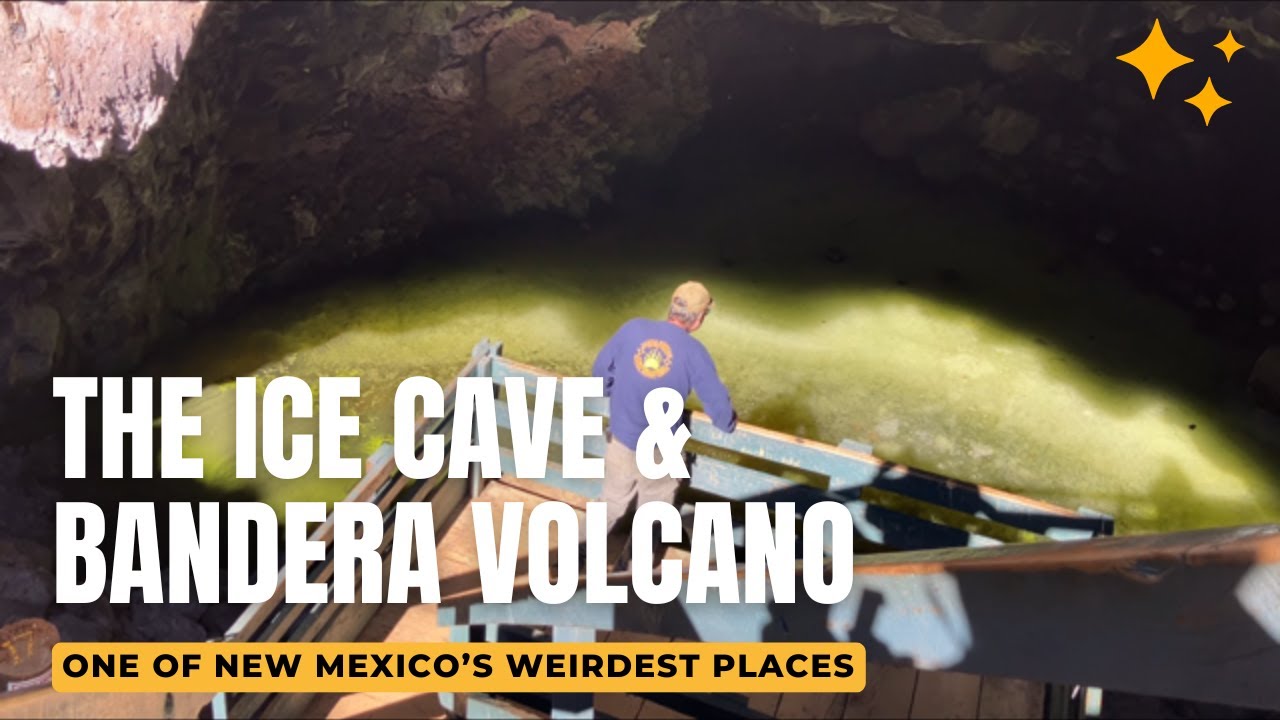
Why it's incredible: The cave is so cold that Arctic algae grow on the ice inside.
The Bandera Volcano Ice Cave is a hollow in the ground in New Mexico where temperatures never exceed 31 degrees Fahrenheit (minus 0.6 degrees Celsius).
The cave formed roughly 10,000 years ago, when the nearby Bandera Volcano violently erupted, spewing lava that solidified at the surface while caverns formed in the layers below. The cave's unusual geology has preserved frigid conditions, which have caused ice to form inside it for at least 3,400 years.
The ice inside the Ice Cave is up to 20 feet (6 meters) thick on the floor year-round. Due to the freezing conditions, Arctic algae have colonized the cave, growing on top of the ice to form a blue-green, living blanket, according to the Ice Cave's website.
The cave is "one of New Mexico's weirdest spots, where it's both hot and cold all at the same time," Paul Mauermann, an environmental educator and director of New Mexico's Sandia Mountain Natural History Center, said in a video.
The Ice Cave is freezing because it is nestled inside a collapsed lava tube. Lava tubes are natural tunnels that form beneath surface lava flows during volcanic eruptions. Because surface flows are in contact with air, they cool and solidify more quickly than the lava flowing closer to the ground. As a result, when a volcano stops erupting, the core of a lava flow drains away while the outside hardens, leaving an empty conduit, or cave.
The Ice Cave has porous walls and an opening that's just the right shape to trap cold air inside the lava tube while keeping the warm air outside. This "natural icebox" is continually replenished through rainfall and snowmelt that freeze upon contact with the icy floor, according to the Ice Cave's website.
Bandera Volcano is also remarkable, as it represents one of the best and most accessible examples of a cinder cone volcanic eruption in North America. This type of eruption is short but explosive, with sprays of lava that crystallize in the air before landing on the ground. This results in steep cones covered in loose fragments that make it hard for anyone to climb some of the volcano's vents.
Sign up for the Live Science daily newsletter now
Get the world’s most fascinating discoveries delivered straight to your inbox.
Bandera is now dormant. One of its vents collapsed during the eruption, forming a 800-foot-deep (240 m) crater that visitors can view from a breach on the south side. Lava likely flowed through this gap and into the valley below, forming a 23-mile-long (37 kilometers) river of molten rock that has since solidified into lava fields, according to the website.
Discover more incredible places, where we highlight the fantastic history and science behind some of the most dramatic landscapes on Earth.
Sascha is a U.K.-based staff writer at Live Science. She holds a bachelor’s degree in biology from the University of Southampton in England and a master’s degree in science communication from Imperial College London. Her work has appeared in The Guardian and the health website Zoe. Besides writing, she enjoys playing tennis, bread-making and browsing second-hand shops for hidden gems.
You must confirm your public display name before commenting
Please logout and then login again, you will then be prompted to enter your display name.