Get the world’s most fascinating discoveries delivered straight to your inbox.
You are now subscribed
Your newsletter sign-up was successful
Want to add more newsletters?
Join the club
Get full access to premium articles, exclusive features and a growing list of member rewards.
An account already exists for this email address, please log in.
The universe's first magnetic fields were 'comparable' to the human brain — and still linger within the 'cosmic web'
New computer simulations suggest the first magnetic fields that emerged after the Big Bang were much weaker than expected — containing the equivalent magnetic energy of a human brain.
The cosmic web, which permeates through the known universe, may contain traces of the first magnetic fields created after the Big Bang. Using computer simulations, researchers now believe they can predict the strengths of these primordial fields.
The universe's first magnetic fields may have been much weaker than we first imagined — and were roughly equivalent to the strength of the magnetic activity within the human brain, according to a new study.
Researchers used hundreds of thousands of computer simulations to examine the remnants of these ancient magnetic fields, which still reside within the "cosmic web" billions of years later.
Magnetism is a natural force generated by the movements of electrical charges and has existed since the early days after the Big Bang, when the infant universe was full of jostling electrically charged particles. Experts have long suspected that the initial magnetic fields created by these particles, known as primordial magnetic fields, were much weaker than those created by complex cosmic objects that exist today, such as stars, black holes and planets.
But in the new study, published Aug. 13 in the journal Physical Review Letters, researchers have revealed that these primordial fields may have been even weaker than they previously imagined. Using exhaustive computer simulations, the team constrained an upper limit on these fields' magnetic strength and found that they likely maxed out at 0.00000000002 gauss, which is billions of times weaker than a standard fridge magnet (~100 gauss).
Such magnetic fields are "comparable to magnetism generated by [the electrical activity of] neurons in the human brain," the researchers wrote in a statement.
Despite their weakness, remnants of these magnetic fields still reside within the intergalactic cosmic web — a mysterious, sprawling structure that permeates the entire known universe — and this was key to uncovering the new findings.
Get the world’s most fascinating discoveries delivered straight to your inbox.
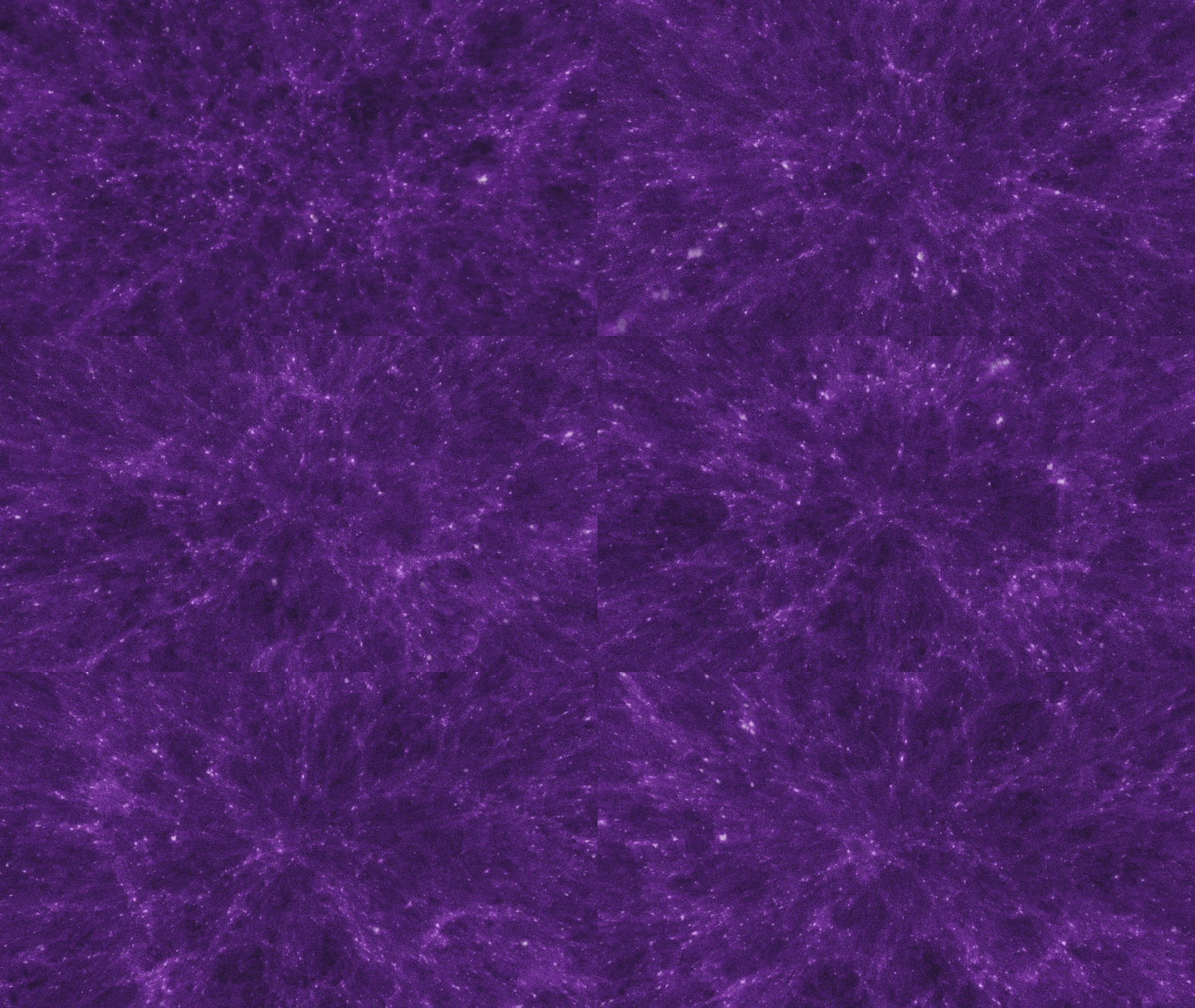
Researchers have only just begun to map out the cosmic web. This animation shows what it might look like if you could move through it faster than light speed.
(Image credit: NASA/NCSA University of Illinois Visualization by Frank Summers, Space Telescope Science Institute, Simulation by Martin White and Lars Hernquist, Harvard University)
The cosmic web is an expansive network of ghostly filaments that connect all the galaxies in the universe like a giant 3D spider's web. There is still a lot we don't know about the cosmic web, including what it is really made of. However, in recent years, scientists have started to image this gigantic structure properly and have begun to map it out in detail.
One of the biggest mysteries about the cosmic web is why it has its own magnetic fields. This is especially confusing in regions of space in-between galaxies, where the web is isolated within large expanses of nothingness.
"Our hypothesis was that this [magnetism] could be a legacy of events occurring in cosmic epochs during the birth of the universe," study lead author Mak Pavičević, a doctoral candidate at the International School for Advanced Studies (SISSA) in Trieste, Italy, and co-author Matteo Viel, an astrophysicist at SISSA, jointly said in the statement. "This is what we sought to ascertain with our work."
Their team believes that the earliest primordial magnetic fields could have been caught up in the initial inflation of the universe and later become intertwined with the cosmic web as it grew in the expanding spaces between galaxies.
The cosmic web connects all the galaxies in the known universe. But there is still much about this mysterious network that we do not fully understand.
(Image credit: Robert Lea (created with Canva))
In the study, the researchers used approximately 250,000 computer simulations, based on observational data of the cosmic web, to reverse engineer this supposed series of events, allowing them to set "strict limits on the intensity of magnetic fields formed in the very early moments of the universe," Pavičević and Viel said.
These findings are still theoretical as there is currently no way of directly observing primordial magnetic fields. However, the researchers claim that the results align with recent findings concerning the cosmic microwave background (CMB), which is the radiation leftover from the Big Bang, although it is unclear which specific findings they are referring to.
The study team also notes that continued observations of the cosmic web with the James Webb Space Telescope (JWST) could allow them to create more powerful simulations to further test their hypothesis in the future.
Harry is a U.K.-based senior staff writer at Live Science. He studied marine biology at the University of Exeter before training to become a journalist. He covers a wide range of topics including space exploration, planetary science, space weather, climate change, animal behavior and paleontology. His recent work on the solar maximum won "best space submission" at the 2024 Aerospace Media Awards and was shortlisted in the "top scoop" category at the NCTJ Awards for Excellence in 2023. He also writes Live Science's weekly Earth from space series.
You must confirm your public display name before commenting
Please logout and then login again, you will then be prompted to enter your display name.