















Killer whales are teaming up with dolphins on salmon hunts, study finds — but not everyone agrees
There are eye-opening claims that orcas and dolphins are working together on salmon hunts and sharing food — but not everyone is convinced.


Orcas living off the coast of British Columbia in Canada have been spotted hunting with dolphins and sharing scraps of salmon with them after making a kill.
The northern resident population of orcas (Orcinus orca), or killer whales, off British Columbia has been observed teaming up with Pacific white-sided dolphins (Aethalodelphis obliquidens) in hunts for Chinook salmon (Oncorhynchus tshawytscha).
The researchers used underwater video, data from suction-cup biologging tags and aerial drone footage to establish how nine northern resident orcas moved and hunted in August 2020 — and how they interacted with Pacific white-sided dolphins around Vancouver Island, Canada.
They captured aerial and underwater footage of the animals' coordinated interactions. The two species in this area generally show few signs of mutual aggression and sometimes seek each other out, which is unusual given that orcas hunt dolphins in other locations, while some dolphins mob orcas.
The researchers recorded 258 instances of dolphins traveling near tagged orcas. In all these cases, the orcas were engaged in foraging-related behaviors, such as killing, eating or hunting for salmon, which are too large for dolphins to capture and swallow whole.
The researchers observed 25 instances of orcas changing course after encountering dolphins, after which both would dive down, potentially foraging. This may be a result of orcas listening out for dolphin echolocations, said study lead author Sarah Fortune, an oceanographer at Dalhousie University in Nova Scotia, Canada.

A Pacific white-sided dolphin approaches a Northern Resident killer whale.
The authors also recorded eight instances of orcas catching salmon, breaking them up and sharing the pieces with other orcas. Dolphins were present on four of these occasions, and on one of them, the dolphins scavenged the conveniently broken-up salmon remains.
Get the world’s most fascinating discoveries delivered straight to your inbox.
"The surprising thing for us is that knowing the resident killer whales are specialists in hunting Chinook salmon, the killer whales should really be the best ones at finding them, so why are they bothering to follow the dolphins?" Fortune told Live Science.
She said the findings are the first documented recording of cooperative hunting and prey-sharing between orcas and dolphins. The research was published in the journal Scientific Reports on Thursday (Dec. 11).
Researchers still aren't sure whether it is a cooperative system that both species benefit from equally, Fortune added. "We haven't been able to quantify the extent to which killer whales and dolphins obtain benefits from this interaction, but from our observations we see positive outcomes for both."
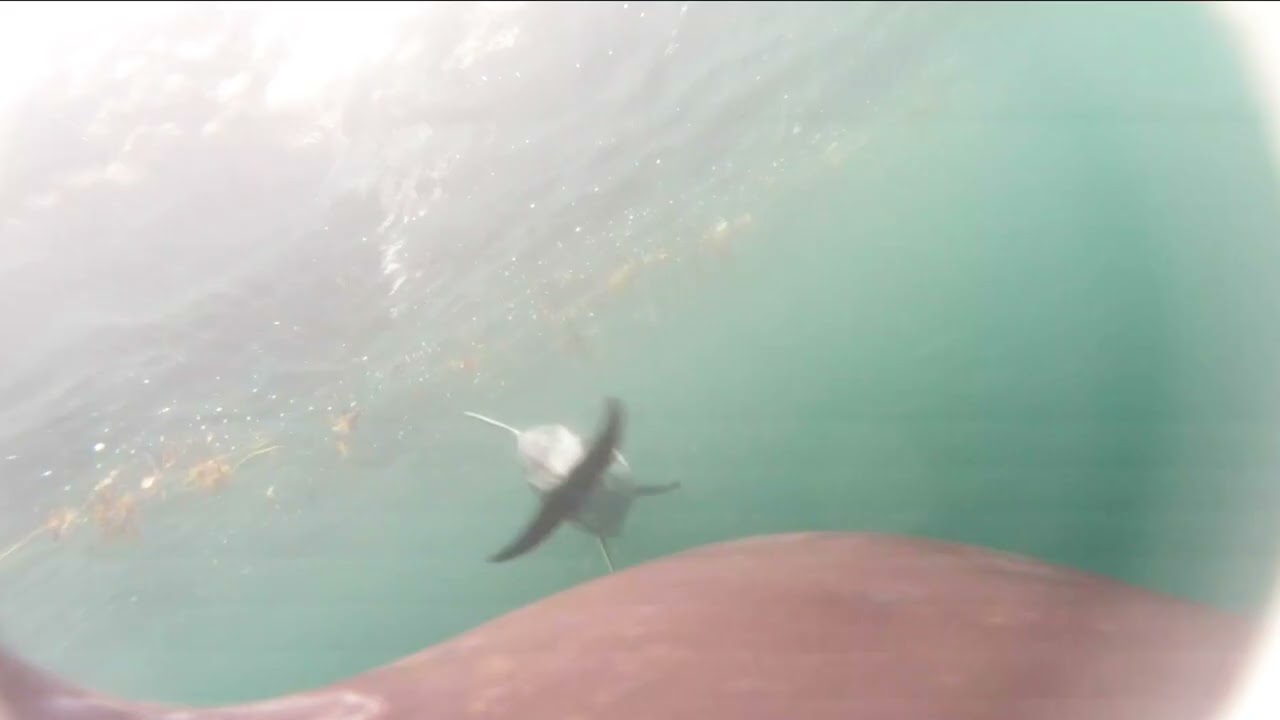
By associating with the orcas, the dolphins may also get protection from other populations of orcas that do hunt dolphins, she said.
"It's perhaps unsurprising, given the learning abilities of toothed whales, that these two species have learned that certain aspects of foraging in the same time and place bring advantages to both species," said Luke Rendell, a reader in biology at the University of St. Andrews in Scotland who wasn't involved in the study. "I find the risk management the dolphins have to do around killer whales is particularly impressive," he told Live Science by email, adding that if you hang out with the wrong orcas "you get eaten."

Researchers aboard the research vessel Steller Quest observe Northern Resident killer whales.
Scrounging for food?
Michael Weiss at the Center for Whale Research in Friday Harbor, Washington who wasn't involved in the research, noted he wasn't sure whether the observed behavior showed the two species working together.
"I'm not completely convinced that what we're seeing here is cooperative; it seems clear that the dolphins can benefit from reduced predation risk and scrounging from killer whale kills, but I think more work needs to be done to demonstrate a benefit to the whales," Weiss told Live Science by email.
Instead, the behavior might be kleptoparasitism ― one animal stealing food that another has already hunted — noted Jared Towers, the executive director of Bay Cetology, a cetacean research institute in Canada, who wasn't involved in the research.
"They provide evidence for the dolphins stealing fish scraps from the killer whale meals and that's really nice to see, because that's exactly what we thought has been happening all these years," Towers told Live Science.

A group of killer whales, dolphins and Dall's porpoise interact at the surface between foraging dives.
He said the coordinated movements also support another hypothesis — the idea of orcas avoiding dolphins, not cooperating with them. "The killer whales take longer dives, they travel further underwater and they reduce vocal activity. To me, this suggests that the killer whales are trying to avoid the dolphins."
Fortune agrees other hypotheses are possible. "The dolphins might be the ones sneaking in and stealing the fish from the killer whales, like a kleptoparasite, but we have observations of dolphins going after salmon at the surface and on at least one occasion you see the dolphin catch a salmon, then it loses it, then tries to catch it again," she said. "It's clear that the dolphins want the salmon but they're not necessarily well adapted morphologically to capture those big fish."
Working with orcas would give the dolphins the means to actually get the fish, she added, while the orcas may be able to locate salmon more easily by following dolphins.
RELATED STORIES
Fortune said further investigation of the relationship between these marine mammals is needed to understand how widespread and consistent any cooperative behaviors may be.
In recent years, orcas have been spotted getting up to all kinds of shenanigans, showing impressive levels of cultural learning. Members of the southern resident population near Washington and British Columbia have been seen wearing salmon on their heads and giving each other massages with kelp. And another group of the smart marine mammals has been damaging boats off the coast of Spain.
Orca quiz: Will you sink or swim?

Chris Simms is a freelance journalist who previously worked at New Scientist for more than 10 years, in roles including chief subeditor and assistant news editor. He was also a senior subeditor at Nature and has a degree in zoology from Queen Mary University of London. In recent years, he has written numerous articles for New Scientist and in 2018 was shortlisted for Best Newcomer at the Association of British Science Writers awards.
You must confirm your public display name before commenting
Please logout and then login again, you will then be prompted to enter your display name.