













Fiber Fabric Could Create Whole-Body Cameras

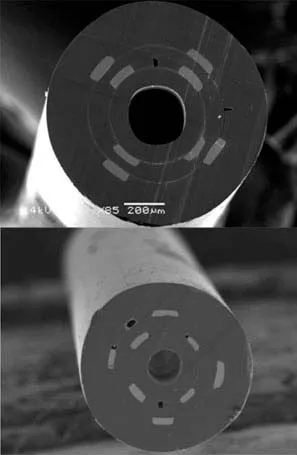
Flexible translucent fibers woven into a fabric can capture light and turn it into images without a camera lens, researchers announced this week.
Scientists say the optoelectronic fiber could lead to bizarre new imaging products like a wall-sized, all-seeing camera or a soldier's uniform that captures 360-degree views.
"Fabric composed of these fibers could be joined to a computer that could provide information on a small display screen attached to a visor, providing the soldier greater awareness of his surroundings," according to a statement from MIT, where the breakthrough was made.
"This is the first time that anybody has demonstrated that a single plane of fibers, or 'fabric,' can collect images just like a camera but without a lens," said MIT material science professor Yoel Fink. "This work constitutes a new approach to vision and imaging."
Fink and colleagues describe the product in the journal Nanoletters.
More work is needed, but the setup offers other advantages over standard camera lenses, such as increased durability, the researchers claim. If one part of a fabric lens were damaged, the rest of the product would continue making pictures.
"We are saying, 'instead of a tiny, sensitive object [for capturing images], let's construct a large, distributed system,'" Fink said. "While the current version of these fabrics can only image nearby objects, it can still see much farther than most shirts can."
Get the world’s most fascinating discoveries delivered straight to your inbox.
The work was supported by the Army Research Office, the National Science Foundation, the Defense Advanced Research Projects Agency (DARPA) and the Department of Energy.
