













Why We Walk and Run vs. Hopping and Skipping

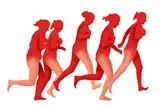
New computer simulations show three modes of locomotion are most efficient for humans: walking, running, and a third one that for some reason we don't employ.
Hopping and skipping are no good. And there's a reason why we don't speed-walk or consistently use other odd ways of getting around, the research found.
Walking and running at typical paces -- the uniquely human gaits you are used to -- use the least amount of energy compared to the performance results, the study found.
Cornell University engineers Andy Ruina and Manoj Srinivasan compare the mechanics of walking and running with "many other strange and unpracticed gaits." They used a set of computer models that simulated physical measurements such as leg length, force, body velocity and trajectory, forward speed and work.
"We wish to find how a person can get from one place to another with the least muscle work," they write.
While we can, if we choose, glide along without much bobbing up and down -- such as when a waiter must be cautious not to spill coffee filled to the brim -- we don't. Here's why:
The computer simulations conclude that normal walking is simply most energy efficient for travel at low speeds, and running is best at higher speeds. And, they report, a third walk-run gait is optimal for intermediate speeds, even though humans do not appear to take advantage of it.
Get the world’s most fascinating discoveries delivered straight to your inbox.
The results are detailed in today's issue of the journal Nature.
A video from the National Science Foundation, which supported the work, details the efficiency of walking and running.
- Jogging Separated Humans from Apes
- Yikes! Vampire Bats Can Run, Too
- New Robots Walk Like Humans
- The Secret of Fast Horses
