 Live Science Plus




You are now subscribed
Your newsletter sign-up was successful
Want to add more newsletters?

Delivered Daily
Daily Newsletter
Sign up for the latest discoveries, groundbreaking research and fascinating breakthroughs that impact you and the wider world direct to your inbox.

Once a week
Life's Little Mysteries
Feed your curiosity with an exclusive mystery every week, solved with science and delivered direct to your inbox before it's seen anywhere else.

Once a week
How It Works
Sign up to our free science & technology newsletter for your weekly fix of fascinating articles, quick quizzes, amazing images, and more
Delivered daily
Space.com Newsletter
Breaking space news, the latest updates on rocket launches, skywatching events and more!

Once a month
Watch This Space
Sign up to our monthly entertainment newsletter to keep up with all our coverage of the latest sci-fi and space movies, tv shows, games and books.

Once a week
Night Sky This Week
Discover this week's must-see night sky events, moon phases, and stunning astrophotos. Sign up for our skywatching newsletter and explore the universe with us!
Join the club
Get full access to premium articles, exclusive features and a growing list of member rewards.
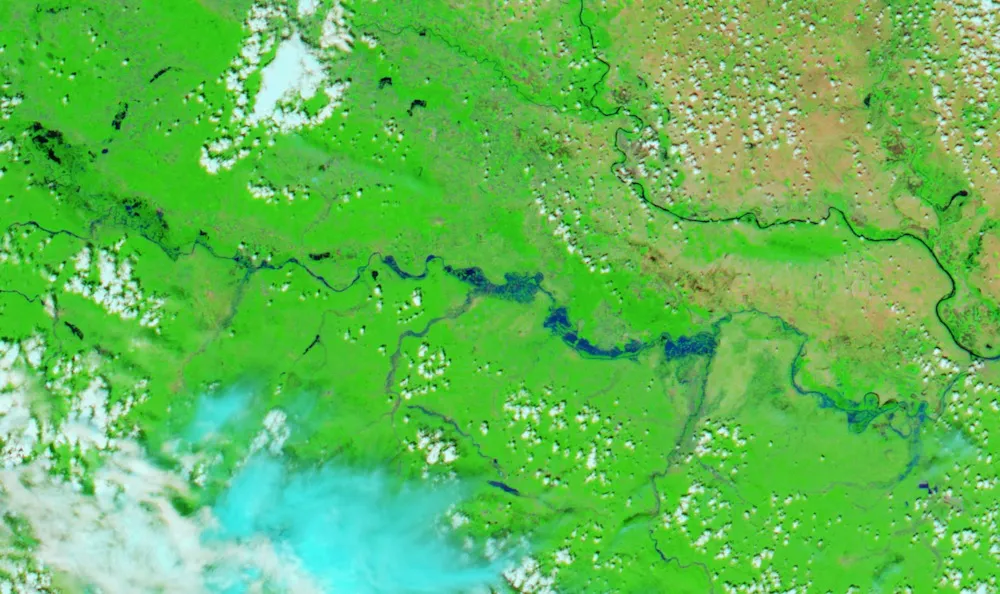
Record-breaking floods in Serbia, Croatia and Bosnia and Herzegovina are visible from space in a new satellite image.
Taken May 19, the image shows rivers swollen by heavy rains. The flooding is the worst in the region since record-keeping started more than a century ago. Three months' worth of rain fell in the region in a matter of three days, according to the BBC. The rain has now cleared, but floodwaters continue to move downstream, so Balkan towns are still bracing for higher waters. Meteorologists expect the flooding in Belgrade, the capital of Serbia, to worsen this week.
Dozens have died, and tens of thousands have evacuated their homes. Complicating the response, the floodwaters have triggered thousands of landslides in this mountainous region. What's worse, buried landmines from the Bosnian War of 1992 to 1995 may have shifted in these slides, posing a danger to rescuers and survivors alike. [Earth from Above: 101 Stunning Images from Orbit]
Rivers rising
The flooding is affecting several major waterways, including the Sava River, the Drina River and the Bosna River. The Danube, Europe's second-longest river, is rising as well, but experts believe it will remain contained.
The new NASA image of the disaster comes courtesy the space agency's Aqua satellite, according to NASA's Earth Observatory. The Moderate Resolution Imaging Spectroradiometer aboard Aqua captured the extent of the flooding. Vegetation is seen in green and bare ground in brown. Water appears black.
The Danube River is the dark band cutting across the image on the upper right. The river snaking across the middle of the image is the Sava, which has been most affected by the flooding so far. Extending off the Sava on the right is the Drina River; to its left is the Bosna. Croatia is on the left of the image, bordered by Bosnia and Herzegovina and then Serbia on the right.
Cause and response
According to Earth Observatory, extra-tropical cyclone Tamara brought Mediterranean moisture to the region, causing the floods. A second image, this one acquired by NASA's Aqua satellite on May 18, 2013, shows the rivers in a typical, non-flood stage.

Landslides and land mines aren't the only dangers facing residents in the aftermath of the flooding. About a quarter of Bosnians lack access to clean water in the wake of the flooding, according to news reports. And tens of thousands of bodies of drowned livestock are posing a health risk, as well. The governments of Serbia and Bosnia are calling for international aid to help what is sure to be a long recovery.
Follow Stephanie Pappas on Twitter and Google+. Follow us @livescience, Facebook & Google+. Original article on Live Science.

