 Live Science Plus





You are now subscribed
Your newsletter sign-up was successful
Want to add more newsletters?

Delivered Daily
Daily Newsletter
Sign up for the latest discoveries, groundbreaking research and fascinating breakthroughs that impact you and the wider world direct to your inbox.

Once a week
Life's Little Mysteries
Feed your curiosity with an exclusive mystery every week, solved with science and delivered direct to your inbox before it's seen anywhere else.

Once a week
How It Works
Sign up to our free science & technology newsletter for your weekly fix of fascinating articles, quick quizzes, amazing images, and more

Delivered daily
Space.com Newsletter
Breaking space news, the latest updates on rocket launches, skywatching events and more!

Once a month
Watch This Space
Sign up to our monthly entertainment newsletter to keep up with all our coverage of the latest sci-fi and space movies, tv shows, games and books.

Once a week
Night Sky This Week
Discover this week's must-see night sky events, moon phases, and stunning astrophotos. Sign up for our skywatching newsletter and explore the universe with us!
Join the club
Get full access to premium articles, exclusive features and a growing list of member rewards.
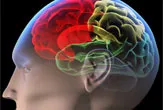
A new map of the brain shows that most key aspects of intelligence are handled in specific spots, while processing speed is distributed throughout the noggin.
Researchers used brain scans to map the mental regions involved in the cognitive work done while taking IQ tests, which remain the most widely-used intelligence tests in the world.
An IQ score on the WAIS test is composed of four indices of intelligence, each consisting of several subtests, which together produce a full-scale IQ score. The four indices are verbal comprehension, perceptual organization (visual and spatial processing), working memory (similar to short-term memory) and processing speed. The researchers correlated the location of brain injuries with scores on each of the four WAIS indices.
"The first question we asked was if there are any parts of the brain that are critically important for these indices or if they are very distributed, with intelligence processed globally in a way that can't be mapped," said Ralph Adolphs, a neuroscientist at Caltech in Pasadena, Calif.
With the exception of processing speed, which appears to draw on neurons scattered throughout the brain, the lesion mapping showed that the other three cognitive indices really do depend on specific brain regions.
The magnetic resonance imaging (MRI) and computerized tomography (CT) brain scans of patients also turned up some surprises. Overlap between brain regions responsible for verbal comprehension and working memory suggest that they represent the same type of intelligence on the WAIS test, even though the test currently considers them separate measures of cognitive ability .
Such details could help with future revisions of the WAIS test, so that its sections are grouped more based on brain mapping results rather than what is observed in behavior. And future brain scans could even predict IQ scores of brain-damaged patients, as well as possibly healthy people, Adolphs noted.
The brain maps from this study might also help clinicians home in on likely areas of brain damage.
"It wouldn't be sufficient to be diagnostic, but it would provide information that clinicians could definitely use about what parts of the brain are dysfunctional," Adolphs said.

