
 Live Science Plus


Male Beluga Whale Mimics Human Voice

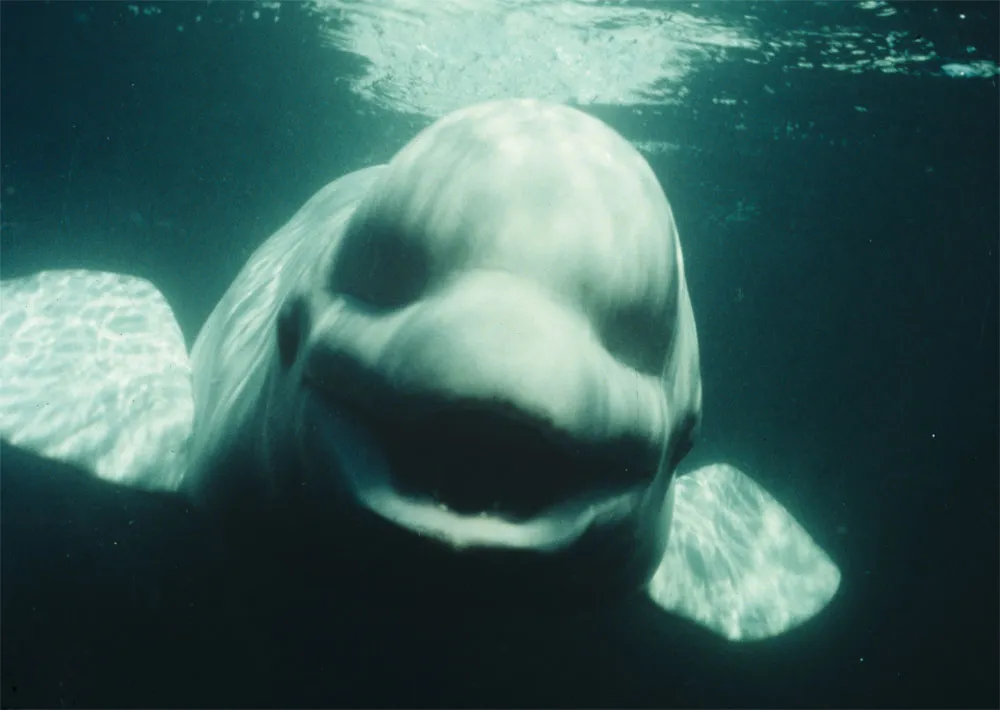
Move over, Moby Dick. Scientists have found a white whale capable of imitating human speech.
These findings, the first to show that whales can mimic the voices of humans, suggest that researchers might want to analyze other whales for similar abilities.
Beluga whales, also known as white whales, are known as "the canaries of the sea" because of how vocal they are. They are not the same kind of whale as the monstrous giant of the story "Moby Dick," which was a white sperm whale — belugas are actually among the smallest species of whales.

Amazing Noc
In 1984, scientists at the National Marine Mammal Foundation in San Diego began noticing unusual noises emanating from where they kept the whales and dolphins. These resembled two people conversing in the distance, just beyond the range of the understanding of listeners.
Researchers traced these sounds back to one male white whale, Noc, when a diver surfaced from the whale enclosure to ask his colleagues an odd question: "Who told me to get out?" The investigators concluded sounds resembling "out" came from Noc. [Listen to Noc Speak Human]
There were plenty of opportunities for Noc to hear human speech. He had previously overheard people talking at the surface, and had also heard them using devices that allowed them to speak with divers underwater.
Anecdotal reports have surfaced in the past of whales sounding like humans. For instance, at Vancouver Aquarium, keepers suggested that a white whale about 15 years of age had uttered his name, "Lagosi."
In a more rigorous test to see if Noc could mimic humans, scientists rewarded him with snacks when he made those sounds, prompting him to do so enough times for them to capture recordings.
Analysis of Noc's sounds revealed a rhythm similar to human speech. They also displayed fundamental frequencies several octaves lower than typical whale sounds and far closer to that of the human voice.
"We were amazed — the voiceprint really reminded us of humanlike sounds and unlike normal whale sounds," researcher Sam Ridgway, neurobiologist, research veterinarian and president of the National Marine Mammal Foundation, told LiveScience. "We never heard anything like this before."
Whale puckers up
These sounds are even more surprising because whales typically produce sounds in a completely different way from people, using their nasal tracts and not the voice box or larynx as humans do. To make these humanlike sounds, Noc had to vary the air pressure in his nasal tract while adjusting liplike valves and over-inflating sacs under his blowhole.
"Such obvious effort suggests motivation for contact," Ridgway said.
Noc's speechlike sounds subsided after about four years, after he matured. Still, he remained quite vocal in other ways for the rest of his 30-year life. (Noc passed away five years ago.)
Ridgway cautioned that people "should not think that whales can communicate with us at a conversational level based on these results." Still, "that is an intriguing possibility for future research to determine what, if anything, could be achieved at a conversational level."
Beluga whales are often kept in captivity, and researchers may want to see if those whales can mimic human sounds as well. "Keepers in aquaria should remain alert to such behavior and see that such events are analyzed with good acoustic methods," Ridgway said.
The scientists detailed their findings in tomorrow's (Oct. 23) issue of the journal Current Biology.
