Just in time for the total lunar eclipse, this beginner-friendly telescope is now $100 off at Amazon
The Celestron StarSense Explorer DX 5-inch Schmidt-Cass is now down to $479 at Amazon, making it easy to enjoy the blood moon eclipse on March 3.


The Celestron StarSense Explorer DX 5-inch Schmidt Cassegrain telescope is one of the most compelling beginner-friendly telescopes on the market — and with the total lunar eclipse happening on March 3, 2026, it's an ideal choice for anyone wanting dramatic views of the moon beyond what astronomy binoculars can offer. Plus, it's now the cheapest it's been since before Black Friday, so it's worth taking advantage of this deal now so you can make the most of the blood moon eclipse.
Get the Celestron StarSense Explorer DX 5-inch Schmidt Cassegrain telescope for $479.97 at Amazon right now. Don't forget to add the coupon at checkout.
Its 5-inch aperture and long 1,250mm focal length deliver bright, high-contrast views with plenty of detail on the moon's craters and surface features. The included 25mm and 10mm eyepieces give a good range for moderate (50x) to strong (125x) magnification for both wide and more detailed lunar viewing — although for even better views, we'd recommend upgrading the eyepieces.
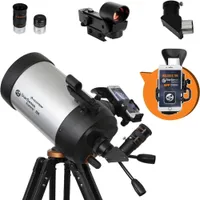

The Celestron StarSense Explorer DX 5-inch Schmidt Cassegrain telescope arrives ready to observe straight out of the box with everything you need to get started. In this deal, you get the optical tube, a tripod with accessory tray, a dual-axis alt-azimuth mount, two eyepieces (25mm and 10mm), a red-dot finderscope and erect image diagonal.
This telescope also comes with a StarSense smartphone dock. Once your phone is in place and the StarSense Explorer app is fired up, it determines exactly where the telescope is pointing and guides you to celestial objects with on-screen arrows, showing a green bullseye when you're perfectly aligned. This system is perfect for beginners who might not yet know their way around the night sky, and ideal for a quick setup if you want to catch the total lunar eclipse on March 3.
Key features: 5-inch (125mm) aperture, 1,250mm focal length, f/10 focal ratio, total kit weight 14.6 pounds (6.62 kg), includes 25mm and 10mm eyepieces.
Product launched: 2021.
Price history: This is almost the lowest price we've seen it. Last November, it went down to $475 before Black Friday, and it usually retails for around $579.99.
Price comparison: Amazon: $479.97 | B&H: $579.99 | Adorama: $579.99
Reviews consensus: We haven't tested this specific model, but we love Celestron as a reliable telescope brand that consistently delivers excellent quality optics that are user-friendly and good value for money. Amazon users rate this telescope 4.1 out of 5 stars.
✅ Buy it if: You're a beginner wanting to invest in a decent first telescope that you won't get bored with after a few uses.
❌ Don't buy it if: You're a seasoned astronomer and want to observe faint deep-sky objects and resolve fine planetary details.