













Cataclysmic crash with neighboring planet may be the reason there's life on Earth today, new studies hint
Early Earth may not have had the right ingredients for life — until a nearby Mars-size planet crashed into it, two new studies hint.

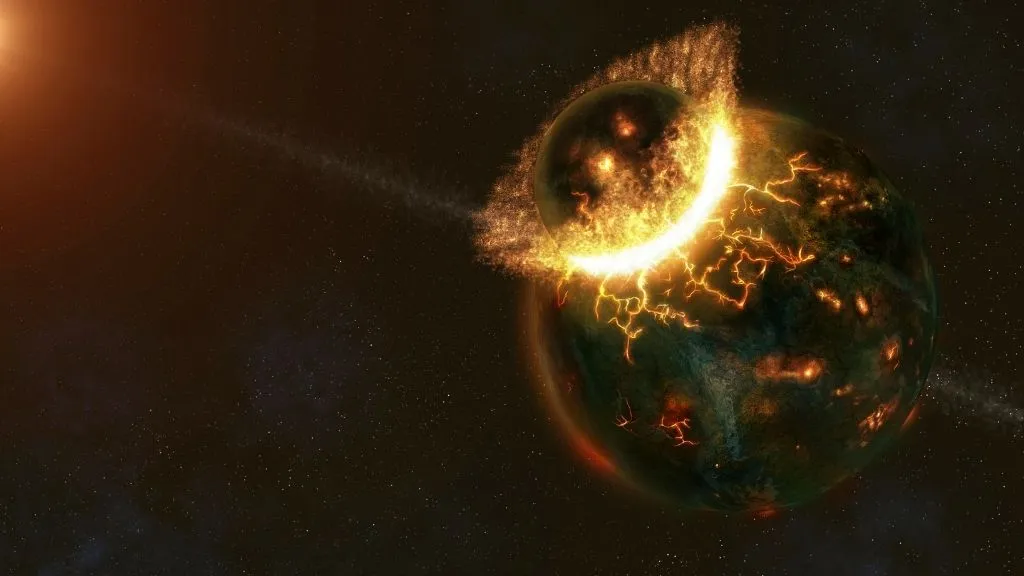
Early Earth was a barren wasteland incapable of supporting life until a big protoplanet crash carried in the necessary ingredients, a new study suggests.
That collision of the proto-Earth and a Mars-size body — nicknamed Theia — has been theorized for decades, especially in discussions of how our moon may have formed from the resulting pieces of the crash.
Now, in a new study, scientists say Theia also brought some of life's key ingredients to our world, more than 4 billion years ago.
"We conclude that the moon-forming impactor Theia originated further out in the solar system [than Earth] and was volatile-rich," study lead author Pascal Kruttasch told Live Science in an email. Kruttasch was a doctoral student at the University of Bern when he performed the study.
Volatiles are chemical compounds that can easily be vaporized, like hydrogen and carbon, but are also considered the building blocks of life. Closer to the sun, temperatures are too high for these materials to condense, meaning they remained in a gas phase near the early Earth and other rocky planets. Farther out, however, there is an abundance of volatiles for gas giant planets like Jupiter and Saturn — as well as comets and asteroids.
Theia was therefore a big deal for Earth, Kruttasch said: It likely shipped these volatiles, which are "essential ingredients for life."
In the study, the researchers used a chemical model to examine isotopes (element types) from meteorites, as well as rocks on Earth.
Get the world’s most fascinating discoveries delivered straight to your inbox.
Related: James Webb telescope images reveal there's something strange with interstellar comet 3I/ATLAS
The team zeroed in on the radioactive decay of an isotope of manganese, which existed in the early solar system and slowly decayed to chromium over several million years This decay timeline enabled the researchers to precisely track the first 15 million years of Earth's formation. (The solar system itself is roughly 4.5 billion years old.)
Figuring out how life got to Earth and remained for billions of years is a complex issue. "Earth is the only planet we know of that has produced life and sustained it for several billion years. It is unclear what processes took place in Earth's history to make this possible," Kruttasch said.

Artist's impression of a protoplanetary system, which may also capture the conditions under which Earth and our solar system was formed.
But peering back at the early solar system gave the team some clues. Proto-Earth and growing planets nearby (which today include Mercury, Venus and Mars) changed quickly in their first 3 million years in an exchange of dust and gas through evaporation and condensation.
However, this exchange process practically ceased after 3 million years because the first rocky planets and gas planets had taken up much of the free matter in our solar system. Simply put, planets closer to the sun were more depleted of volatile elements than those that were farther away due to the higher temperatures of the inner planets closer to the sun.
That's why Earth's volatiles must have come from a large source like Theia, which is estimated to have collided with our planet roughly 4.5 billion years ago. (In line with other studies, the new work assumes Theia is a type of chondrite, which is a stony material rich in carbon and organic compounds that tends to form far out from the sun.)
The larger implication of these findings is that life may be difficult to conjure on exoplanets that are similar to Earth, given that most volatiles may have formed in a different region of the solar system. "This [study] makes it clear that life-friendliness in the universe is anything but a matter of course," study co-author Klaus Mezger, a professor emeritus of geochemistry at the University of Bern, said in a statement.
The researchers published their findings Aug. 1 in the journal Science Advances. However, this wasn't the only recent study to discuss Theia and its impact on Earth's life.
RELATED STORIES
Unrelated research slated to be published in the Nov. 15 issue of the journal Icarus suggests Theia delivered a lot of water to our planet — and is still visible in the mantle of our planet.
This mantle water is a puzzle to geologists, because "water is less dense than the materials typically found in the Earth's mantle, and it was supposed to have come to the crust or oceans," study co-author Pedro Machado, an astrophysicist at Portugal's Institute of Astrophysics and Space Sciences, said in a translated statement.
The simulation-based study suggested that Theia delivered much of the water in the mantle to the early Earth, "and there hasn't been time for this water to reach the surface," Machado added.

Elizabeth Howell was staff reporter at Space.com between 2022 and 2024 and a regular contributor to Live Science and Space.com between 2012 and 2022. Elizabeth's reporting includes multiple exclusives with the White House, speaking several times with the International Space Station, witnessing five human spaceflight launches on two continents, flying parabolic, working inside a spacesuit, and participating in a simulated Mars mission. Her latest book, "Why Am I Taller?" (ECW Press, 2022) is co-written with astronaut Dave Williams.
You must confirm your public display name before commenting
Please logout and then login again, you will then be prompted to enter your display name.