













A remnant of a protoplanet may be hiding inside Earth

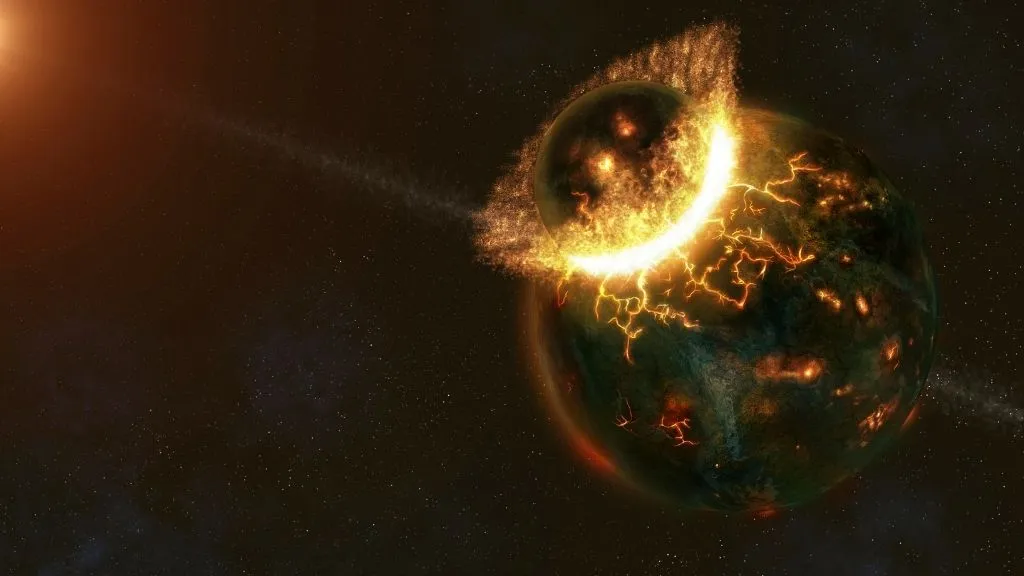
A protoplanet slammed into the Earth about 4.5 billion years ago, knocking loose a chunk of rock that would later become the moon. Now, scientists say that remnants of that protoplanet can still be found, lodged deep inside Earth, Science Magazine reported.
If remains of the protoplanet, known as Theia, did stick around after the impact, that may explain why two continent-size blobs of hot rock now lie in the Earth's mantle, one beneath Africa and the other under the Pacific Ocean. These massive blobs would stand about 100 times taller than Mount Everest, were they ever hauled up to Earth's surface, Live Science previously reported.
Theia's impact both formed the moon and transformed Earth's surface into a roiling magma ocean, and some scientists theorize that the blobs formed as that ocean cooled and crystalized, Science reported. Others think the blobs contain Earth rocks that somehow escaped the effects of the collision and nestled, undisturbed for millions of years, near the planet's center.
But last week, at the Lunar and Planetary Science Conference, Qian Yuan, a doctoral student in geodynamics at Arizona State University (ASU) Tempe, presented an alternate hypothesis.
Related: Earth has a hidden layer, and no one knows exactly what it is
He proposed that, after the moon-forming impact, dense material from Theia’s mantle descended deep beneath the Earth's surface, accumulating into what we now know as "the blobs." According to Yuan's models, rocks 1.5% to 3.5% denser than Earth's mantle would not mix into the surrounding rock. Rather, they would sink to the bottom of the mantle, near the inner core.
"This crazy idea is at least possible," Yuan told Science.
Get the world’s most fascinating discoveries delivered straight to your inbox.
A 2019 study, published in the journal Geochemistry, supports the idea that Theia's mantle was denser than Earth's — about 2% to 3.5% denser, Science reported. The study authors drew conclusions about Theia's size and chemical composition based on an analysis of Apollo moon rocks, which contained a far higher ratio of light hydrogen to heavy hydrogen than Earth rocks, they found. (Light and heavy hydrogen differ by the number of neutrons in each atom's nucleus.)
To supply the moon with so much light hydrogen, Theia must have been very large, nearly the size of Earth at the time of impact, and very dry, since water formed in interstellar space would contain a heavy form of hydrogen called deuterium, which Theia lacked, the authors concluded. Meanwhile, the interior of the hulking protoplanet would have held a dense, iron-rich mantle, Science reported.
Related Content
Per Yuan's theory, while the lighter rocks hurtled into space to form the moon, chunks of the iron-rich mantle would have barreled down toward the Earth's core in the wake of Theia's impact, where they settled and formed the enigmatic blobs. "I think [the idea is] completely viable until someone tells me it’s not," Edward Garnero, a seismologist at ASU Tempe who was not involved in the work, told Science.
However, not everyone's convinced. You can read more about competing theories of how the blobs formed at Science Magazine.
Originally published on Live Science.

Nicoletta Lanese is the health channel editor at Live Science and was previously a news editor and staff writer at the site. She is a recipient of the 2026 AHCJ International Health Study Fellowship, with a project focused on antibiotic stewardship practices in Japan and the U.S. They hold a graduate certificate in science communication from UC Santa Cruz and degrees in neuroscience and dance from the University of Florida. Beyond Live Science, Lanese's work has appeared in The Scientist, Science News, the Mercury News, Mongabay and Stanford Medicine Magazine, among other outlets. Based in NYC, she also remains involved in dance and performs in local choreographers' work.